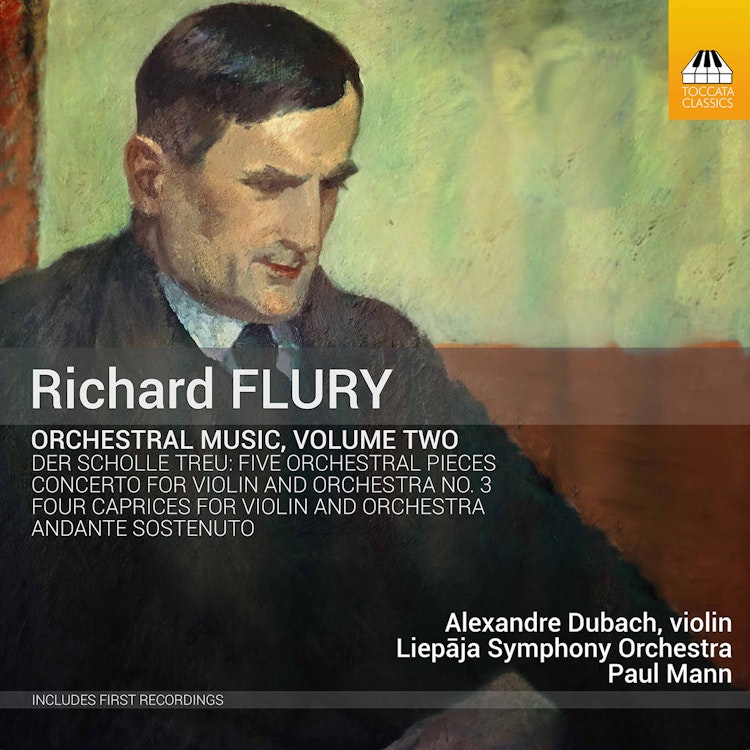
Richard Flury's orchestral works are noted for imaginative harmonies, transparent and inventive scoring, often displaying Impressionistic traits, and sometimes venturing to the boundaries of tonality.
Critical Reception
Despite working as a music teacher in a provincial town, Richard Flury's significance was recognized by many prominent musicians of his time, including Wilhelm Backhaus, Pau Casals, and Richard Strauss, who performed his works.
Composer Biography
Richard Flury, born in 1896 in Biberist, Switzerland, received his initial musical education at home and later studied at universities and conservatories, taking violin lessons and composition.
Performer Biography
Alexandre Dubach, the violinist on this recording, won the Concours National of the 1964 Expo in Lausanne at age nine and later studied with renowned violinists such as Yehudi Menuhin and Nathan Milstein.
Cultural Impact
Richard Flury was one of Switzerland's most prolific composers, with a work catalogue that includes operas, symphonies, ballet, instrumental concertos, vocal works, chamber music, and songs.
Composer's Artistic Vision
Richard Flury was committed to late Romanticism, viewing music as a language of emotions and rejecting constructivist approaches, always seeking to express new ideas within tonality.
Recording & Production
None of the purely orchestral works on this recording were orchestrated by Richard Flury himself; instead, they were orchestrated by his friend Edouard Favre, his son Urs Joseph Flury, and conductor Paul Mann.
You might also enjoy...
Gluzman plays Barber, Bernstein and Bloch Concertos
Symphony No. 25, Violin Concerto No. 2
Kernis: Air for Violin; Barber: Violin Concerto; Bloch: Baal Shem; Walton: Violin Concerto