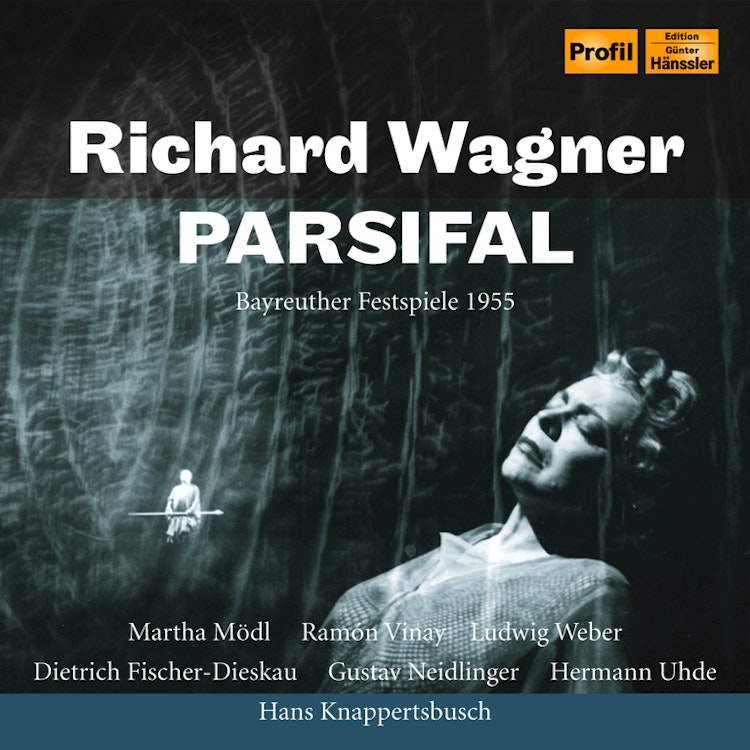
Richard Wagner - Parsifal- Bayreuther Festspiele 1955
6/2/2023, 47 Tracks, 4:08:42
Featuring
Hans Knappertsbusch
Dietrich Fischer-Dieskau
Hermann Uhde
Ludwig Weber
Ramón Vinay
Gustav Neidlinger
Martha Mödl
Josef Traxel
Alfons Herwig
Paula Lenchner
Elisabeth Schärtel
Gerhard Stolze
Alfred Pfeifle
Ilse Hollweg
Friedl Pöltinger
Dorothea Siebert
Jutta Vulpius
Orchester der Bayreuther Festspiele
Chor der Bayreuther Festspiele
Richard Wagner
Did you know?
1/7
Historical Context
This 1955 Bayreuth Festival performance of "Parsifal" was part of the first post-war festival, which opened on July 30, 1951.
Recording & Production
For this 1955 Bayreuth Festival recording, the problem of the Grail bells was solved by using an electronic musical instrument created by Oskar Sala.
Composer's Artistic Vision
Wieland Wagner, the director and grandson of Richard Wagner, believed that his grandfather's legacy should not be 'mummified' or preserved as a museum piece, leading him to break with tradition in his productions.
Performer Biography
Conductor Hans Knappertsbusch, who preferred conducting "Parsifal" in Bayreuth until 1964, once refused to conduct in 1953 because Wieland Wagner had removed the dove from the final scene.
Critical Reception
Wieland Wagner's "Parsifal" production received mixed critical reactions; some German critics found it 'shapeless' and 'tedious', while Ernest Newman of the Sunday Times called it one of the 'most moving spiritual experiences' of his life.
Notable Performances
Wieland Wagner's production of "Parsifal" was performed annually at the Bayreuth Festival from 1951 to 1973, making it the longest-running "Parsifal" production there after the 1882 premiere.
Interpretation
Wieland Wagner's staging for "Parsifal" used a disc as the main performance area, simple costumes, and relied on light and shadow instead of fixed stage sets, aiming to reflect Parsifal's changing moods.