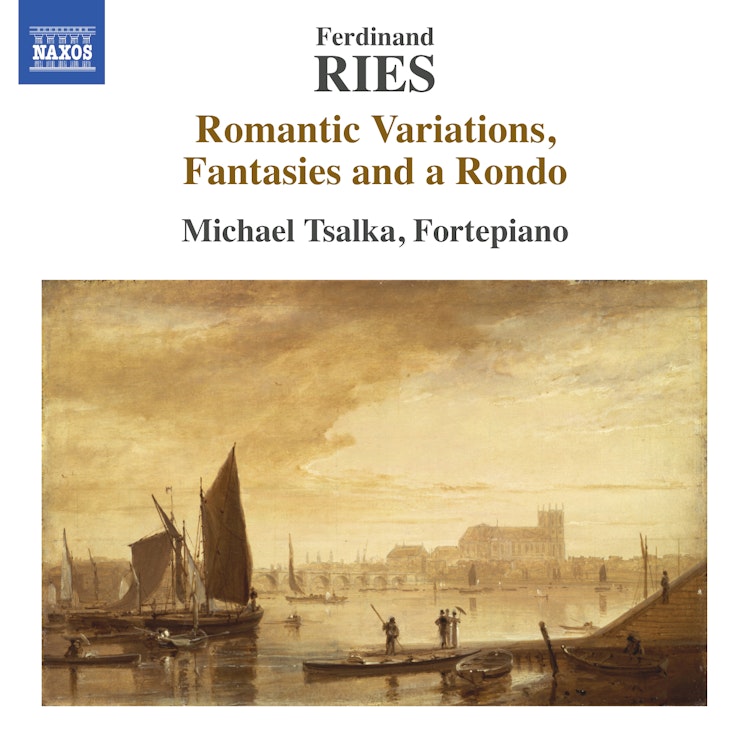
Ferdinand Ries, the composer, was a pupil, friend, and secretary of Beethoven, and co-authored a collection of reminiscences about their relationship.
Compositional Technique
Ries's variations often open with simple, melodic themes followed by multiple sections of varying difficulty and contrasting expression, creating a cumulative dramatic effect similar to Mozart's variations.
Instruments
The fortepiano was constantly evolving during Ries's active period, with variations between countries and manufacturers, leading to the use of Viennese instrument reproductions for this recording due to their clarity and responsive action.
Historical Context
During Ries's time in London (1813-1824), square pianos by firms like Broadwood and Clementi became popular in middle-class homes, creating a demand for short, melodic, and technically accessible pieces.
Performer Biography
Michael Tsalka, the fortepiano performer, holds three degrees from Temple University, including a Master's in Chamber Music, a Master's in Harpsichord Performance, and a Doctorate in Piano Performance.
Critical Reception
A critic in The Harmonicon II (1824) described Ries's piano playing as "romantic wildness," distinguished by strong contrasts, liberal use of pedals, and bold modulations.
Instruments
Johann Schantz (1762-1826) was a respected Viennese fortepiano maker whose instruments were praised by Joseph Haydn and recommended by Beethoven for their beautiful treble and light touch.
You might also enjoy...
Piano Recital: Pasini, Marco - Hummel, J.N. / Moscheles, I. / Kuhlau, F. / Liszt, F. / Busoni, F. / Dallapiccola, L. (A Tribute To Paganini)
Leschetizky: Piano Works
Gulda: Works (Live)
Henry Litolff: Piano Music, Vol. 1
Weber: Piano Sonata No. 2, Rondo brillante, Invitation to the Dance & Polacca brillante
Waltzing Strauss. Johann Strauss Transcriptions for Piano
Felix Mendelssohn: Early Piano Music
'900
Szymanowska: Complete Dances for Solo Piano
Liszt: Hungarian Rhapsodies for Piano (Complete)
J. Andrychowicz, Emilia Potocka, Józefina Wejnert, Maria Szymanowska: Piano Works