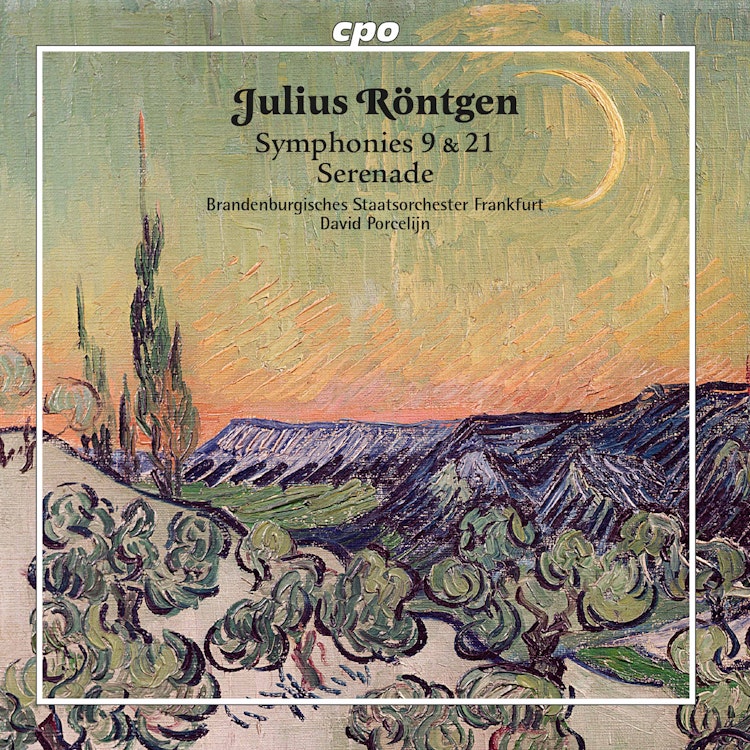
Julius Röntgen, like Johannes Brahms, initially struggled with composing symphonies, only beginning his symphonic output in earnest eight years after writing a serenade.
Critical Reception
The Serenade failed to gain a place in the repertoire, with no other conductor showing interest, reflecting Julius Röntgen's marginalization by the musical establishment of his time.
Composition History
Julius Röntgen's 1902 Serenade, written while recuperating in Semmering, received only one performance during his lifetime, conducted by himself.
Performer Biography
David Porcelijn, the conductor on this album, has held chief conductor and artistic director positions with several symphony orchestras and has conducted many major orchestras worldwide.
Compositional Technique
Julius Röntgen's Symphony No. 9, nicknamed 'The Bitonal,' explores bitonality—the simultaneous use of two keys—a technique he also used in other works like his Viola and Piano Sonata.
Compositional Technique
Julius Röntgen's Symphony No. 21 in A minor is based on a fractured, generally descending chromatic melody, which serves as a recurring motif throughout the work.
Composer's Artistic Vision
Julius Röntgen considered his own compositional style to be 'honest and unmodern,' focusing on 'warm, deeply felt emotion and inspiration' rather than the 'so-called newness' of modern music.
You might also enjoy...
Sibelius: Symphonies Nos.4-7; The Swan of Tuonela; Tapiola