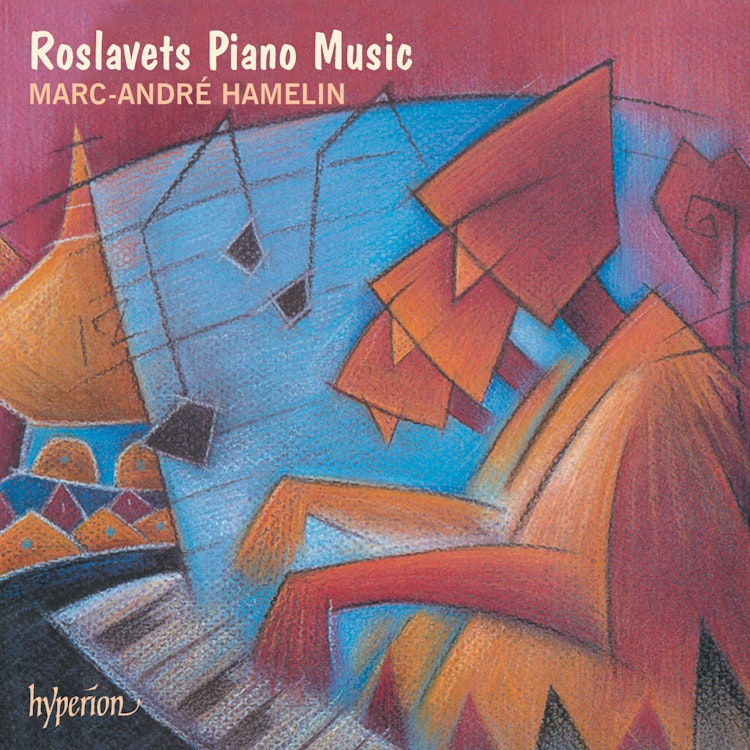
Roslavets allied himself with Russia's artistic vanguard by 1915, with his compositions being the only musical contributions in Futurist art publications.
Composer Biography
Nikolay Roslavets, despite his rural, autodidactic background, became a prolific composer and a prominent figure in Moscow's modernist musical circles.
Composer Biography
Roslavets, a supporter of the 1917 Revolution, held important posts in the Commissariat of Public Enlightenment and Internal Affairs, proclaiming himself a 'proletarian composer'.
Historical Context
The new music that flourished in Russia during the 1910s and 1920s was effectively silenced by the Communist political agenda in the 1930s, branded as 'formalist'.
Compositional Technique
Roslavets's 'new system of tone organization' uses 'synthetic chords' that, through transposition, govern a work's pitch-structural plan in both harmonic and melodic dimensions.
Compositional Technique
Between 1913 and 1919, Roslavets formulated a 'new system of tone organization' based on manipulating 'synthetic chords'—collections of six to eight or more notes.
Critical Reception
Roslavets's compositions were well received by his modernist peers, who quickly recognized his ambition to be the most radical of all Russian musical innovators.
You might also enjoy...
Shostakovich: Piano Sonata No. 2 in B Minor, 24 Preludes & Aphorisms
Godowsky, L.: Piano Music, Vol. 5
Coincidentia Oppositorum: Piano Works by Bach, Liszt & Greif