Soviet musical life in the 1920s was marked by conflict between the Association for Contemporary Music (ASM), to which Roslavets belonged, and the Russian Association of Proletarian Musicians (RAPM).
Critical Reception
The critic Nikolai Miaskovsky praised Roslavets's First Sonata, noting its 'significant, individual, and extraordinary' nature, but also its 'enormous technical difficulties' for performers.
Composer Biography
Nikolai Roslavets was declared an 'enemy of the people' in 1929 and spent the rest of his life in obscurity in Moscow after several years in Tashkent.
Composer Biography
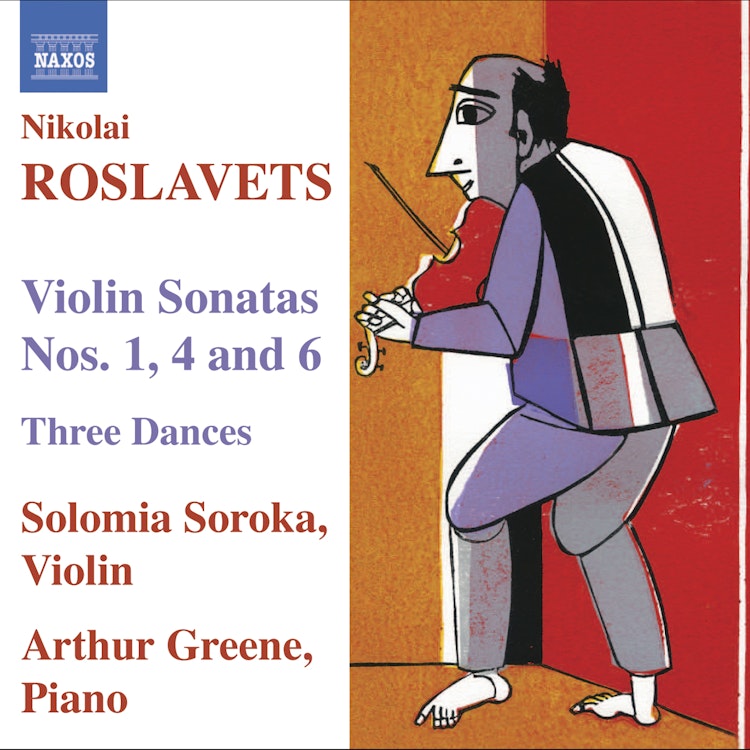
Nikolai Roslavets, a composer featured on this album, was born in 1881 in a small village in what is now Ukraine and began his musical journey playing violin in a local peasant string ensemble.
Performer Biography
Arthur Greene, the pianist on this album, performs the complete solo piano works of Brahms and the cycle of ten sonatas and complete Etudes of Scriabin.
Performer Biography
Solomia Soroka, the violinist on this album, made her solo debut with the L'viv Philharmonic at age ten, performing Mendelssohn's Violin Concerto.
Compositional Technique
Nikolai Roslavets described his compositional building blocks as 'synthetic chords,' which contain melodic and motivic material vertically and can be systematically transposed.
You might also enjoy...
Rediscovering Three American Composers
Henri Vieuxtemps: Pieces For Violin And Piano Vol. II
Ives: Sonatas For Violin And Piano
Dvarionas: Complete Works for Violin & Piano
Peterson-Berger: Violin Sonatas
Enescu - Schubert - Schoenberg - Henze
Consolations - Liszt: Six Consolations & Other Reflective Pieces for Violin & Piano
Sibelius, J.: 5 Danses Champetres / Pieces for Violin and Piano (Musical Soiree at Ainola)
Other Finnish Works for Violin
Mordkovitch, Lydia: Violin Sonatas by Brahms, Prokofiev, Schubert, Strauss, R. Schumann and Faure