The premiere of Mosè in Egitto was well-received by the press and public, with Rossini reporting that the 'oratorio fills the theatre every evening'.
Recording & Production
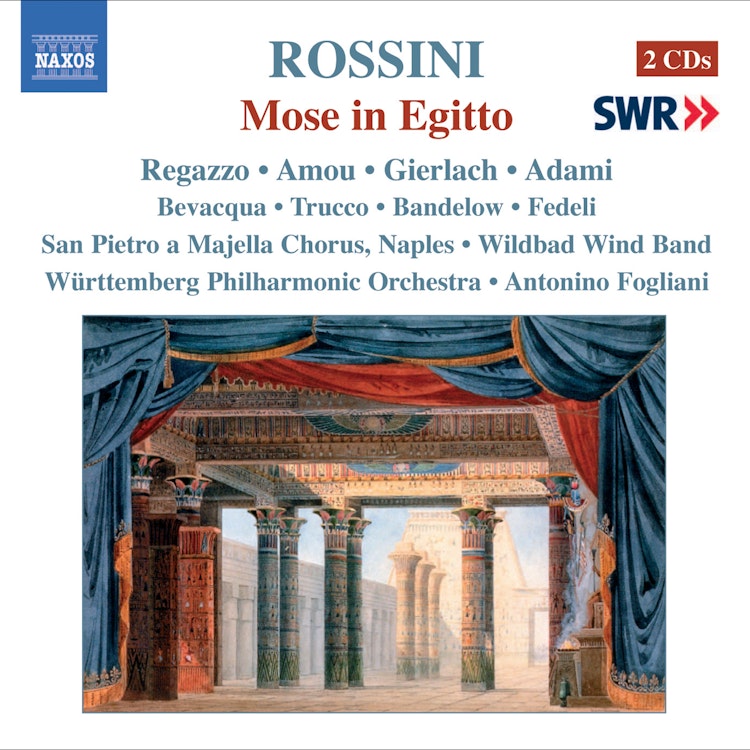
This recording features Michele Carafa's original aria for Faraone and Rossini's later aria for Faraone allocated to Mosè, a solution previously used by Ferdinand Hérold for Paris in 1822.
Composer's Artistic Vision
Rossini considered his 'oratorium' (Mosè in Egitto) a 'superior genre' and wrote it for his fame, not caring if the audience understood it.
Compositional Technique
Rossini's Mosè in Egitto uses dark woodwinds and brass, including a 'serpentone', to create a 'divine halo' effect, a technique also used by Baroque composers for mysterious voices.
Composition History
The only disappointment at the premiere was the staging of the Red Sea passage, which led to a complete reworking of the third act for the 1819 revival.
Compositional Technique
The famous prayer 'Dal tuo stellato soglio' in Act III of Mosè in Egitto features a 'banda' (incidental music) with Rossini copying all parts himself, a practice he later abandoned.
Composition History
Rossini's opera, Mosè in Egitto, was consciously made part of a local tradition of Lenten opera in Naples, where biblical subjects were performed during the fasting period.