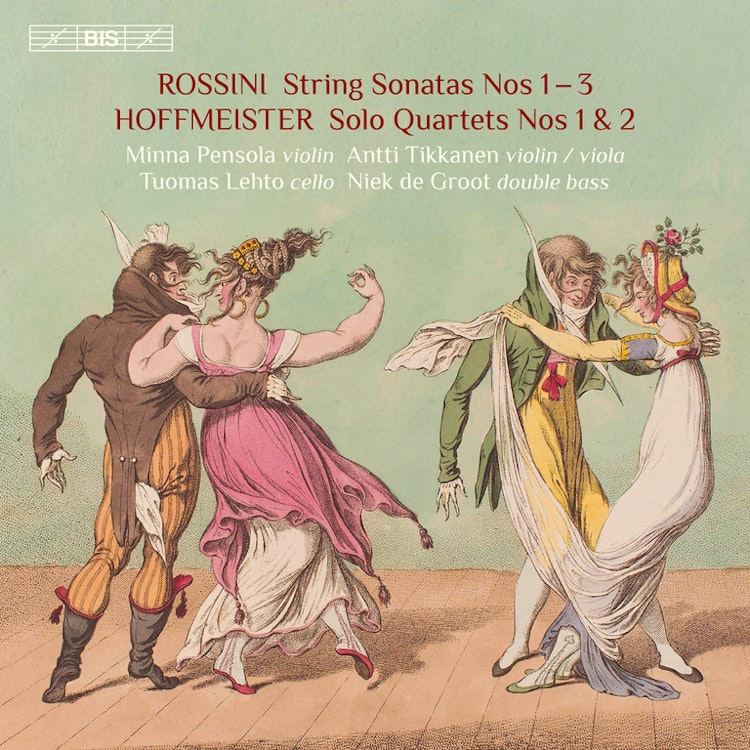
Franz Anton Hoffmeister, though little known today, was a central figure in Viennese musical life in the late 18th and early 19th centuries, publishing works by Haydn, Mozart, and Beethoven.
Composition History
Rossini's Six String Sonatas were composed when he was twelve years old, at the request of a wealthy merchant and amateur double bass player, Agostino Triossi.
Compositional Technique
The Rossini String Sonatas were written for a specific combination of instruments (two violins, cello, and double bass) because of the players available at the time, including Rossini himself on second violin.
Composer's Artistic Vision
Rossini's early works, though not operatic, already show his melodic genius and theatrical flair, with themes that are lively, cheerful, and sometimes sensual, hinting at his future success in opera buffa.
Compositional Technique
Hoffmeister's 'Solo Quartets' feature the double bass as the leader, replacing the first violin in a string quartet, and allow the instrument to showcase its lyrical qualities beyond just virtuosity.
Composition History
Rossini composed and copied out his Six String Sonatas in just three days, before he had even had any lessons in basso continuo.
Recording & Production
The first of Hoffmeister's four 'Solo Quartets' for double bass, violin, viola, and cello had never been edited or published until this very recording.
You might also enjoy...
Brahms: String Quartets & Piano Quintet
Brahms: String Quartet No. 2 in A Minor, Op. 51 No. 2: III. Quasi menuetto. Moderato – Allegretto vivace
Brahms: String Quartets Nos. 1 in C Minor & 2 in A Minor
Mendelssohn: String Quartets Vol. 2
Beethoven: String Quartet No.15
Aeolus Quartet performs Brahms and Bartok
Beethoven: String Quartet in C-Sharp Minor, Op. 131