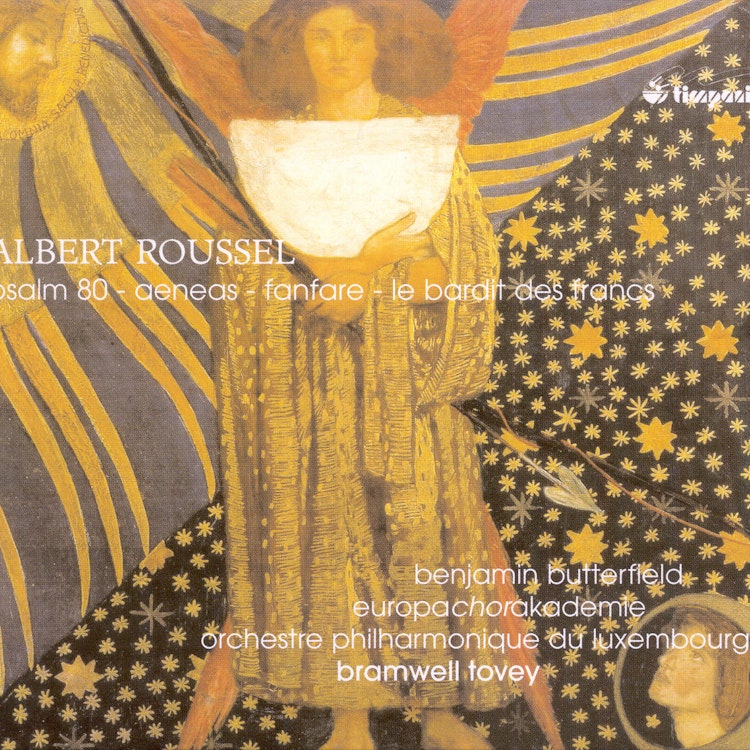
Roussel, A.: Aeneas / Psalm 80 / Fanfare Pour Un Sacre Paien / Le Bardit Des Francs
1/1/2004, 16 Tracks, 1:04:03
Featuring
Bramwell Tovey
Benjamin Butterfield
Orchestre Philharmonique du Luxembourg
EuropaChorAkademie
Albert Roussel
Did you know?
1/7
Recording & Production
The Orchestre Philharmonique du Luxembourg, the performing orchestra, received a 'Cannes Classical Recording of the Year' award in 2002 for its recording of Cydalise et le Chèvre-pied by Pierné.
Composer Biography
Albert Roussel, the composer, served as a young midshipman on the ship Iphigénie in 1890, where he recorded his preference for the poetic nature of Greek mythology over the austere rewards of Christianity.
Composition History
Albert Roussel's Fanfare pour un sacre païen (Fanfare for a pagan coronation) was composed in October 1921 at the request of British critic Leigh Henry, marking the beginning of Roussel's 'Greco-Latin' works.
Compositional Technique
In Psalm 80, Albert Roussel uses bitonality in a highly personal manner and masterfully handles the fugue, creating a rich orchestral palette with rarely doubled voices.
Notable Performances
The premiere of Albert Roussel's Psalm 80 took place at the Paris Opera on April 25, 1929, as part of celebrations for the composer's sixtieth birthday.
Composer's Artistic Vision
After World War I, Albert Roussel shifted his compositional style from descriptive music to pure, abstract music, embracing polytonality and polymodality.
Performer Biography
Bramwell Tovey, the conductor, became chief conductor and musical director of the Orchestre Philharmonique du Luxembourg in September 2002 after twice stepping in at the last minute for indisposed conductors.
You might also enjoy...
Hi-Fi a la Española & Popovers
Orchestral Music (French) - Mehul, E.-N. / Berlioz, H. / Lalo, E. / Saint-Saens, C. / Charpentier, G. / Roussel, A. / Dupont, G.E.X.
Eine Anthologie (Live) [Remastered 2021]
Ride of the Valkyries - Wagner, Mozart, Beethoven, Bach, Mendelssohn
Karl Böhm - The Early Years
Langgaard, R.: Symphonies Nos. 15, "Sostormen" and 16, "Syndflod Af Sol"