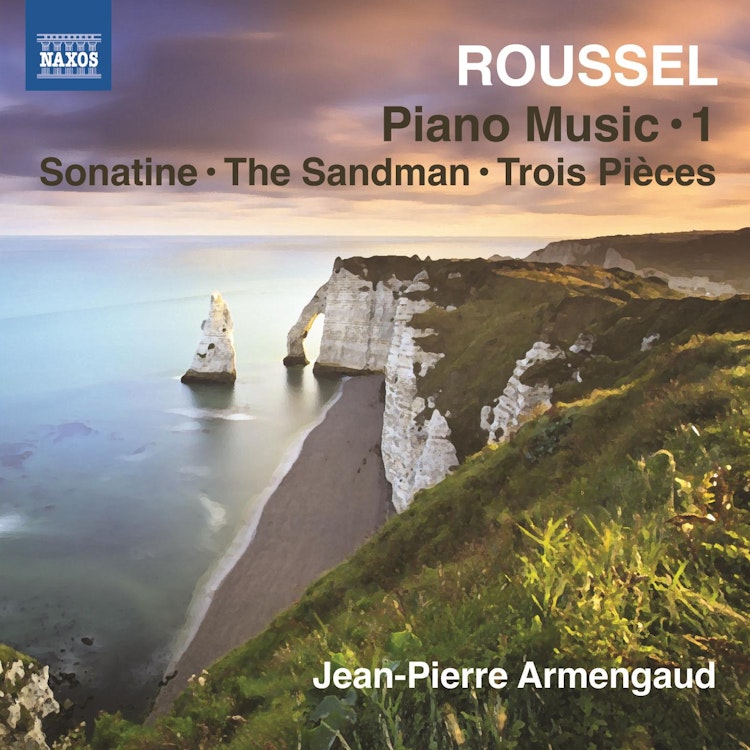
The sea held a lifelong fascination for Roussel, and he was laid to rest in a clifftop cemetery near Dieppe, France.
Compositional Technique
A 'Tristanesque' motif, a rare trace of Wagnerian influence in Roussel's music, recurs throughout Le Marchand de sable qui passe.
Composer Biography
Albert Roussel, the composer, was originally destined for a career at sea but decided to become a musician after studying harmony.
Composer Biography
Roussel taught counterpoint at the Schola Cantorum, a Parisian music school, where his pupils included notable composers Erik Satie and Edgar Varèse.
Composition History
Roussel's incidental music, Le Marchand de sable qui passe (The Sandman), was written in 1908 for a symbolist verse play by Georges Jean-Aubry.
Composition History
L'Accueil des Muses (The Muses' Welcome) was Roussel's contribution to a tribute supplement for the late composer Claude Debussy, published by La Revue musicale in 1920.
Performer Biography
Jean-Pierre Armengaud, the pianist on this album, is known for his extensive repertoire from Bach to Boulez and has recorded the complete piano works of Debussy, Satie, and Roussel.
You might also enjoy...
Virtuoso Piano Transcriptions
Mokranjac: Piano Works
Friedman: Piano Works
Pontinen, Roland: Music for A Rainy Day
Piano solo con sordino
Palsson, Hans: I Doda Mastares Sallskap, Vol. 5
Passages
Ponce: Complete Piano Works, Vol. 4
Piano Cubano
Kurtág's Ghosts
Liszt: Late Piano Music
Franz Liszt: Scherzo and March, Mephisto Waltz No. 1, Harmonies poétiques et religieuses (excerpts) & other piano works