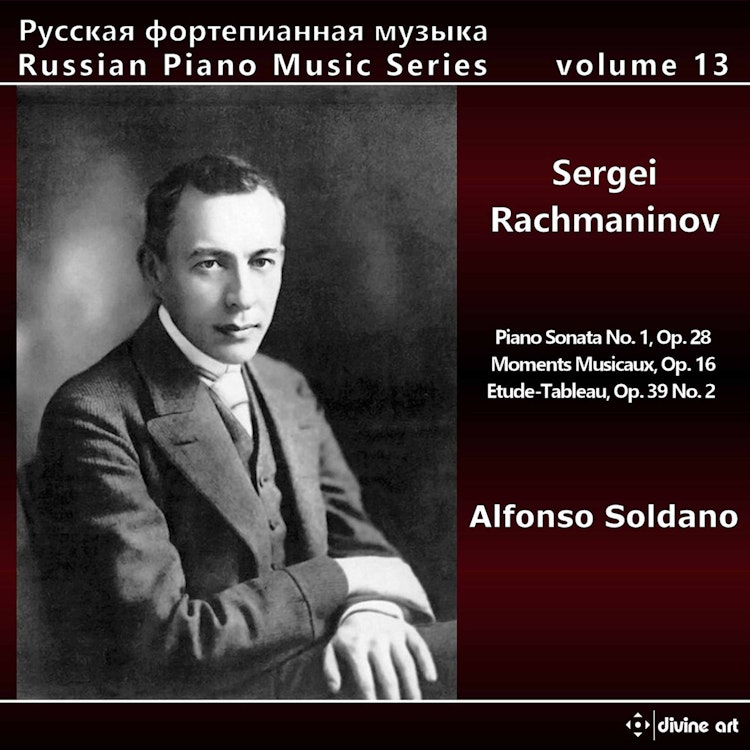
Russian Piano Music Series, Vol. 13: Sergei Rachmaninoff
2/14/2020, 10 Tracks, 1:19:50
Featuring
Alfonso Soldano
Sergei Rachmaninoff
Did you know?
1/7
Composer's Artistic Vision
Sergei Rachmaninov, a pianist-composer, aimed to express his heart's moods—love, bitterness, sadness, or religion—directly in his music.
Composition History
Rachmaninov's monumental First Piano Sonata, composed in 1906, was inspired by the literary subject of Faust and is considered his most demanding work for solo piano.
Historical Context
Rachmaninov escaped the October Revolution and moved to America, where he achieved fame and economic ease, but maintained a 'fortress' of emigrés in his Beverly Hills residence due to his longing for his homeland.
Composition History
Rachmaninov's Moments Musicaux, composed in 1896, was his first work truly representative of his style, combining youthful explosiveness with a tribute to 19th-century compositional traditions.
Composer Biography
Rachmaninov was considered by Tchaikovsky to have a bright future and trained under Nikolai Zverev and his cousin Alexandr Ziloti, a pupil of Franz Liszt.
Composer Biography
Rachmaninov was a multifaceted musical figure—conductor, performer, and composer—and did not choose a single path, finding a plurality of commitments after the success of his famous Second Concerto.
Compositional Technique
Rachmaninov's Etudes-Tableaux, written between 1916 and 1917, feature more radical rhythmic and sonic effects than his earlier works, with the second Etude in A minor improvising on the Dies Irae theme.