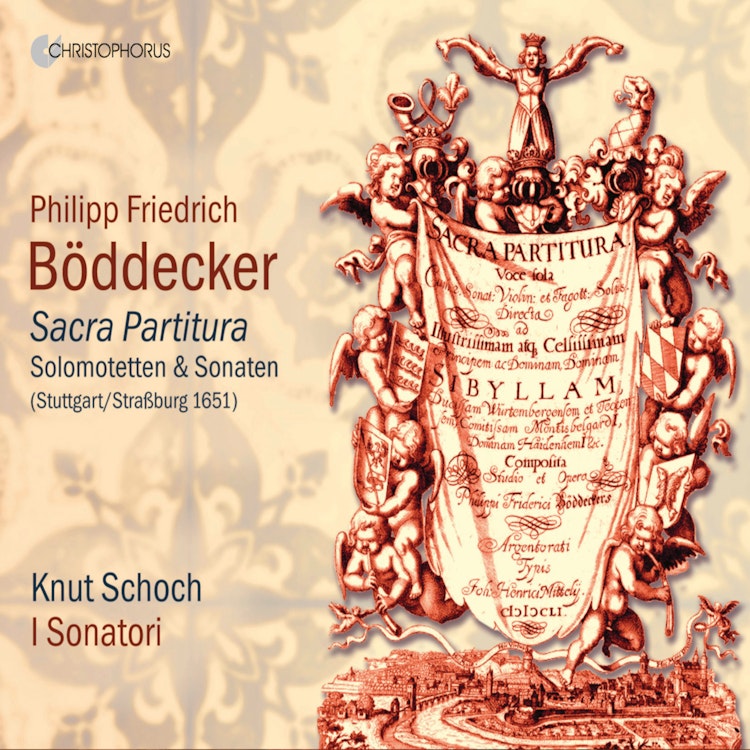
Four of the twelve motets in Sacra Partitura are not Böddecker's own compositions, but adaptations of works by prominent Italian composers Gasparo Casati and Claudio Monteverdi.
Composer Biography
Philipp Friedrich Böddecker, the composer of Sacra Partitura, received his musical education from his father, Joachim Böddecker, and Johann Ulrich Steigleder, who was also his predecessor as organist.
Recording & Production
For this recording, the ensemble used a ¼-comma meantone temperament, a common tuning in Böddecker's time, which makes eight major keys sound pure but renders four others unusable.
Composer's Artistic Vision
Böddecker's Sacra Partitura, a collection of motets and sonatas, reflects the trend of 'small-scale sacred concertos' that flourished in German-speaking regions, combining contrapuntal writing with soloistic text articulation and basso continuo.
Interpretation
The ensemble 'I Sonatori' chose a specific recording dramaturgy, altering the order of pieces from the original 1651 print and including instrumental works by other Stuttgart composers.
Historical Context
Böddecker's appointment as organist in Stuttgart in 1652 was intended to help restore the church's music, which had suffered greatly during the Thirty Years' War.
Composition History
Böddecker's Sacra Partitura is dedicated to Duchess Sibylla, the music-loving sister of Duke Eberhard III, who is also known as the last employer of Johann Jakob Froberger.
You might also enjoy...
Briceño: El Fenix de Paris
Via Crucis
Chamber and Vocal Music (16Th-17Th Centuries) – Reade, R. / Johnson, J. Ravenscroft, T. / Morley, T. (The Ladyes Delight)
Scalfi Marcello: Complete Solo Cantatas
Christmas In Darmstadt (Noël À Darmstadt) Vol. 3
Mayr: Concertos
Juan Montón y Mallén: Alienta, mortal, alienta
Note Femminili: Compositrici Lombarde dal XVII al XIX Secolo
Ostinato
Jacquet De La Guerre, E.: Judith / Violin Sonata in D Minor / Le Sommeil D'Ulisse / Campra, A.: Le Lys Et La Rose (Cecilia's Circle)