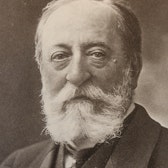
Camille Saint-Saëns, born in Paris in 1835, was an extraordinary musical prodigy who made his concert debut as a pianist at age ten.
Composition History
The Suite in D major, Op. 49, was originally composed for harmonium in 1863, an instrument popular in 19th-century France, before Saint-Saëns prepared an orchestral version in 1869.
Performer Biography
Guillermo Pastrana, the Spanish cellist on this recording, began his studies at age six and now lives in Basle, enjoying an active international career.
Composer Biography
Saint-Saëns was a keen traveler, with Egypt and Algeria being his preferred holiday venues, and he died in Algeria in 1921.
Composition History
The Serenade in E flat major, Op. 15, composed in 1865, is notable for its eccentric original scoring of piano, organ/harmonium, violin, and viola/cello, and was dedicated to Princess Mathilde Bonaparte Demidoff, who exempted Saint-Saëns from military service.
Performer Biography
Jun Märkl, the conductor, was honored by the French Ministry of Culture with the Chevalier de l'Ordre des Arts et des Lettres in 2012 for his tenure with the Orchestre National de Lyon and his Debussy cycle.
Composer's Artistic Vision
Saint-Saëns' compositional approach evolved from championing progressive figures like Wagner and Liszt in his youth to a more conservative stance later in life, reacting against innovators like Debussy and Stravinsky.
You might also enjoy...
FAURE: Orchestral Music
Hindemith: Sancta Susanna / Nusch-Nuschi-Tanze / Tuttifantchen: Suite / 3 Gesange
Fauré: Masques et bergamasques & Pelléas et Mélisande
Sibelius: Pelleas and Melisande / Swanwhite / King Christian Ii
Comédie et tragédie, Vol. 2
Sibelius: King Christian II, Pelleas et Melisande & Swanwhite
Sibelius: Suites from Pelléas et Mélisande, King Christian II & Swanwhite
Rimsky-Korsakov: Maid of Pskov (The) / Fairy Tale
Bizet-Serebrier: Carmen Symphony / Bizet: L'Arlesienne Suites Nos. 1 and 2
Grieg: Piano Concerto; Peer Gynt Suites Nos.1 & 2
Grieg: Piano Concerto; Peer Gynt Suites Nos.1 & 2
Sibelius: Scenes Historiques I and Ii / Rakastava / Valse Lyrique