Pianist Louis Lortie's second album of Camille Saint-Saëns's piano concertos completes the cycle with Nos. 3 in E flat major and 5 in F major, 'Egyptian'. Saint-Saëns himself was the first soloist in both works, premiering No. 3 in Leipzig in 1869 and No. 5 in Paris in 1896, at a jubilee concert in his honour. Two more works for piano and orchestra complete the collection. Lortie is joined by the BBC Philharmonic and Edward Gardner.
Featuring
Louis Lortie
Edward Gardner
BBC Philharmonic
Camille Saint-Saëns
Did you know?
1/7
Composition History
Saint-Saëns's Fifth Piano Concerto, subtitled 'Egyptian,' draws inspiration from his travels, with the second movement evoking croaking frogs and quoting a Nubian love song heard on the Nile.
Recording & Production
This album was recorded using 24-bit / 96 kHz technology, which provides a dynamic range up to 48 dB greater and 256 times the resolution of standard 16-bit recordings.
Composer Biography
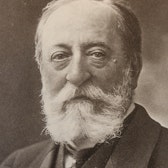
Camille Saint-Saëns, born in 1835, was considered a classicist but was also at the forefront of musical change in the 1860s.
Compositional Technique
Saint-Saëns's Third Piano Concerto includes two sizeable cadenzas in unusual places, making the first movement more like a fantasia than a typical sonata form.
Critical Reception
The premiere of Saint-Saëns's Third Piano Concerto in 1869 received a hostile reception, with the slow movement even inciting 'punch-ups in the corridors' due to its unconventional key and harmonies.
Composition History
The Rhapsodie d'Auvergne was inspired by a folk song Saint-Saëns heard a peasant woman singing while washing clothes in a stream in the Auvergne region of France.
Composer's Artistic Vision
In his Fifth Piano Concerto, Saint-Saëns deliberately avoided the Wagnerian style, suggesting to his compatriots that other sources of inspiration were available beyond the dominant German influence.
You might also enjoy...
Tchaikovsky: Piano Concerto No.1; Variations on a Rococo Theme
Saint-Saëns: Piano Concertos Nos. 1 & 2
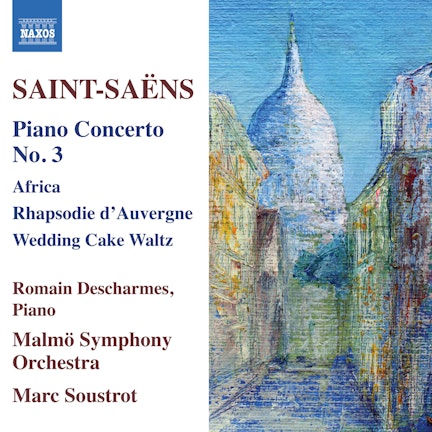
Saint-Saëns: Piano Concerto No. 1, Wedding Cake, Rhapsodie d'Auvergne & Africa
Döhler & Dreyschock: Piano Concertos (Hyperion Romantic Piano Concerto 61)
Tellefsen & Kalkbrenner: Piano Concertos
Glazunov & Goedicke: Piano Concertos (Hyperion Romantic Piano Concerto 13)
Rheinberger & Scholz: Piano Concertos (Hyperion Romantic Piano Concerto 76)
Saint-Saëns: The Complete Music for Piano & Orchestra
Tchaikovsky: Piano Concertos
Everybody's Rachmaninoff: Piano Concertos Nos. 2 & 3, Rhapsody on a Theme of Paganini, Piano Sonata No. 2 and Vocalise
Glazunov : Complete Concertos
Saint-Saëns: Piano Concertos, Vol. 2
Schumann: Piano and Orchestra works
Rachmaninov: Concertos Para Piano No. 2 em Dó Menor, Op. 18 e No. 4 em Sol Menor, Op. 40