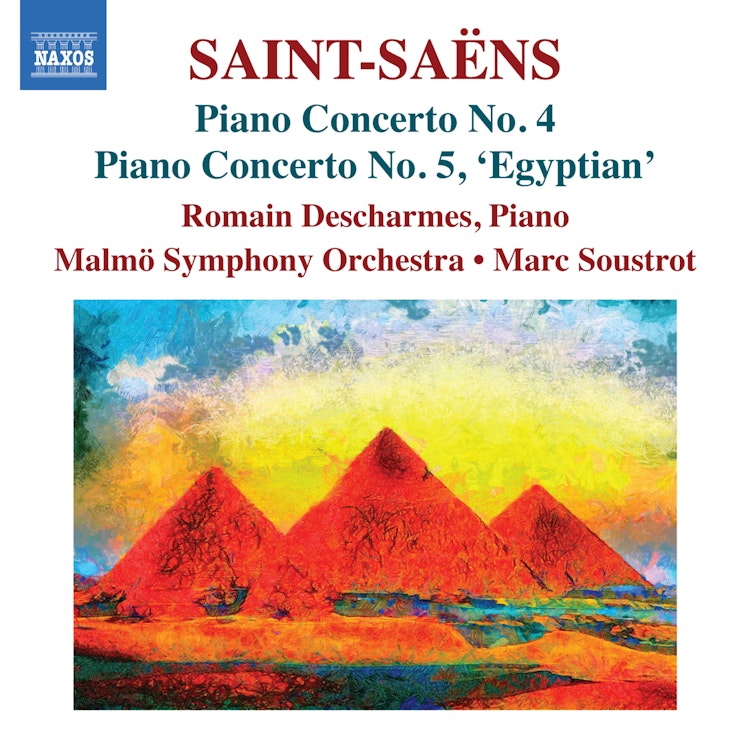
Romain Descharmes, the pianist on this album, is considered one of the foremost French pianists of his generation and is a winner of the Dublin Competition.
Compositional Technique
The 'Egyptian' Piano Concerto No. 5 is a rich tapestry of cultural influences, including Javanese, Spanish, and Middle Eastern music, and features musical portrayals of Nile crickets and croaking frogs.
Compositional Technique
Saint-Saëns's Piano Concerto No. 4 eschews the traditional three-movement form, instead comprising two 'official' movements, each divided into two 'sub-movements,' similar to his Symphony No. 3, the 'Organ Symphony'.
Composer's Artistic Vision
Saint-Saëns championed progressive figures like Wagner and Liszt in his youth, but later adopted a more conservative approach, reacting against innovations by Debussy and Stravinsky.
Composition History
The nickname 'Egyptian' for Piano Concerto No. 5 stems from its place of composition in Luxor, Egypt, where Saint-Saëns frequently vacationed to escape Parisian winters.
Composition History
The Piano Concerto No. 5, 'Egyptian', was composed in 1896 for Saint-Saëns himself to play at his Jubilee Concert, celebrating the 50th anniversary of his debut.
Composer Biography
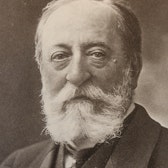
Camille Saint-Saëns, born in Paris in 1835, was an extraordinary musical prodigy who made his concert debut at age 10.
You might also enjoy...
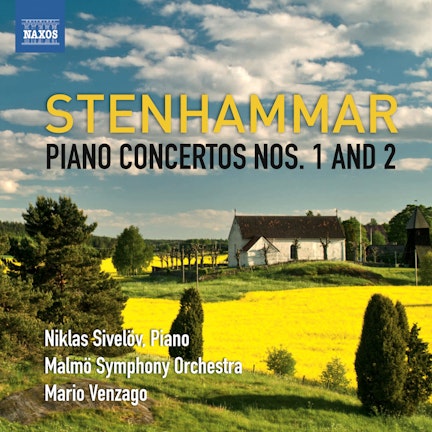
Stenhammar: Piano Concertos Nos. 1 & 2
Schumann: Piano Concerto in A Minor, Op.54: 2 - Intermezzo (Andantino grazioso)
Grieg: Piano Concerto in A Minor, Op. 16: II. Adagio
FIELD: Piano Concertos Nos. 1 and 3
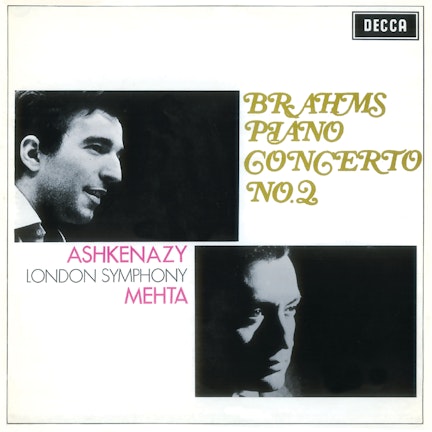
Brahms : Piano Concerto No.2
Franck: Symphonic Variations / Piano Concerto No. 2
Brahms: Piano Concerto No. 2 in B-Flat Major, Op. 83
Brahms: Piano Concerto No. 1 in D Minor, Op. 15: 2. Adagio
Liszt, F.: Piano Concertos Nos. 1 and 2 / Totentanz
Brahms Piano Concertos
Schumann: Piano Concerto in A Minor, Op. 54 & Grieg: Piano Concerto in A Minor, Op. 16 - Sony Classical Masters