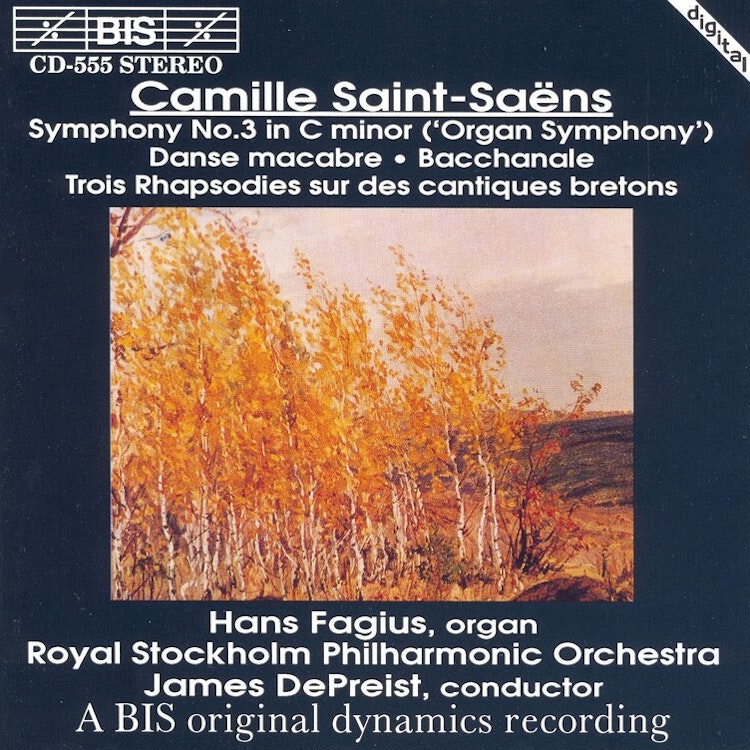
The Rhapsodies sur des cantiques bretons were inspired by Saint-Saëns' visit to Brittany, where he experienced a local religious celebration called 'Pardon'.
Composition History
Saint-Saëns' Symphony No. 3 in C minor, 'Organ Symphony', was commissioned by the Philharmonic Society in London for its 73rd season and composed in just a few weeks in spring 1886.
Compositional Technique
The 'Organ Symphony' features an extensive orchestra including triple woodwind, a brass section with three trumpets, percussion, strings, an organ, and a piano (sometimes played two-hand, sometimes four-hand).
Compositional Technique
In the 'Organ Symphony', the organ plays a significant role, appearing on equal terms with the orchestra, a treatment not seen since Baroque organ concertos.
Composer Biography
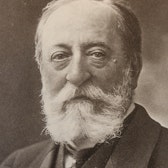
Camille Saint-Saëns, born in 1835, was a child prodigy who gave his first concerts at age 11 and won a first prize for organ playing at the Paris Conservatoire by 1851.
Composer Biography
Saint-Saëns was an organist and teacher of church music at just 18, with Gabriel Fauré, a renowned French composer, among his pupils.
Composer Biography
Saint-Saëns' fame was widespread, attracting visits from great musical figures like Clara Schumann, Franz Liszt, Pablo de Sarasate, and Anton Rubinstein.
You might also enjoy...
Saint-Saens: Symphony No. 3 / Le Rouet D'Omphale
Busoni: 2 Studies On Doctor Faust / Franck: Psyche Et Eros / Dvorak: Symphony No. 8 (1958, 1971)
Karajan 1980s
Saint-Saëns: Symphony No. 3 in C minor; Phaéton; Danse macabre; Danse bacchanale
Georges Prêtre - The SWR Recordings
Saint-Saens: Symphony No.3 "Organ"; Bacchanale from "Samson et Dalila"; Prélude from "Le Déluge"; Danse macabre
Rachmaninoff: Symphonies & Orchestral Music
Franck: Symphonie en Ré Mineur, Ce qu'on entend sur la montagne & Hulda, Ballet allégorique
Erich Leinsdorf Conducts Wagner, Strauss & Rimsky-Korsakov
Mussorgsky: Pictures at an Exhibition, Night on Bald Mountain & Khovanshchina (Excerpts) - Borodin: In the Steppes of Central Asia