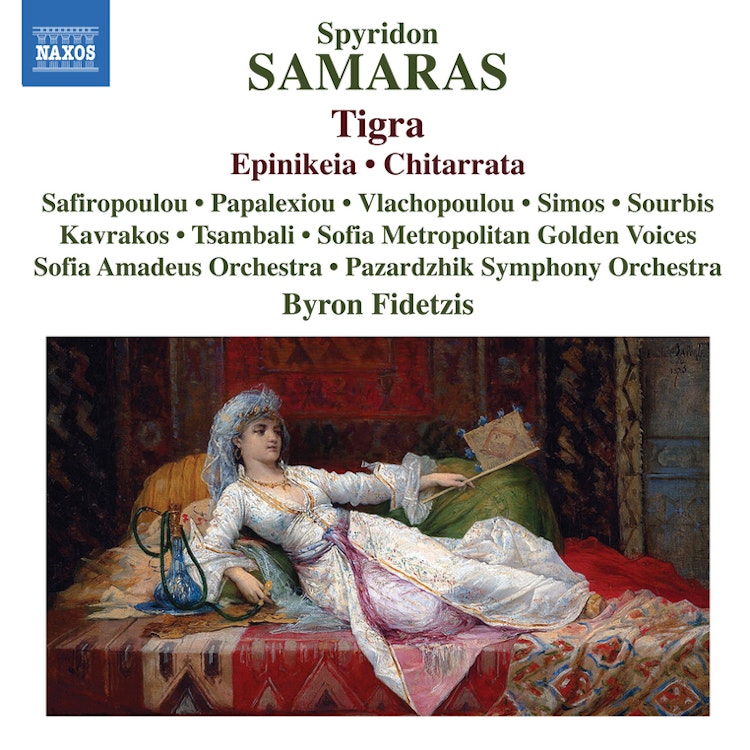
The youthful work Chitarrata features an unusual instrumentation including flutes, oboes, mandolins, guitars, percussion, cellos, and double basses.
Recording & Production
This album features world premiere recordings of all included works, which were restored and edited by conductor Byron Fidetzis from original manuscripts.
Historical Context
The album is a contribution to the 200th anniversary of the Greek Revolution of 1821, reflecting the idea of national restoration through art that was central to the modern Greek National School of music.
Compositional Technique
In his mature works like Tigra, Samaras used bold harmonic choices, church modes, and the whole-tone scale to create a charming atmosphere of musical Orientalism.
Composition History
Chitarrata, a youthful work by Samaras, was likely premiered in Paris in 1885 and is dedicated to the composer's mother.
Composer's Artistic Vision
Spyridon Samaras, the composer, blended Greek folk and church melodies with French and Italian operatic styles, foreshadowing the Greek National School of music.
Composition History
The score for Samaras's opera Tigra was orchestrated by Byron Fidetzis, the conductor on this album, in 2009, after he found a handwritten particello and libretto in the composer's archives.
You might also enjoy...
Everybody's Mozart: Highlights from Don Giovanni and The Marriage of Figaro
Bellini: I Capuleti e i Montecchi
Bellini: I Capuleti e i Montecchi
Arturo Toscanini Conducts Verdi
Zemlinsky: A Florentine Tragedy & Six Maesterlinck Songs
Auber: Fra Diavolo / Donizetti: La figlia del reggimento