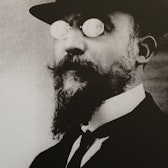
At the age of 39, Satie returned to school to study under Vincent d'Indy and Albert Roussel at the Schola Cantorum in Paris, despite Roussel being younger than him.
Composer Biography
Erik Satie, a Franco-Scottish composer, was baptized in the Anglican church, a very rare event in France, due to his English mother of Scottish origin.
Composer's Artistic Vision
Satie was a fervent anti-Wagnerian, and his influence led Claude Debussy, a fellow French composer, to change his early Wagnerian course.
Compositional Technique
Satie was an early exponent of several important trends in 20th-century music, including bitonality, polytonality, non-triadic harmony, jazz, and 'furniture music' (musique d'ameublement).
Composer's Artistic Vision
Satie's piano music on this album practically spans his entire career, with his 'Premier Menuet' (First Minuet) being his very last piano piece, written in 1920.
Notable Performances
Satie's breakthrough came at age 51 with the scandalous premiere of his ballet Parade in 1917, performed by the Ballets Russes with an orchestra including a typewriter and siren, in collaboration with Jean Cocteau and Pablo Picasso.
Composer Biography
Satie's father, who started as a shipbroker, ended up as a stationer and music publisher, publishing some of his son's earliest works.
You might also enjoy...
Piano Solos of Erik Satie
Rarities of Piano Music 1996: Live Recordings from the Husum Festival
Satie: Complete Piano Works, Vol. 1/2
Satie : Oeuvres pour piano
Satie : Piano Works
Erik Satie: Piano Works
Dances and Dreams: Piano Music from Around the World
Satie: Piano Music
Time Remembered
The Sound of Erik Satie
Satie: Piano Music
Piano Recital: Kubalek, Antonin - Beethoven, L. Van / Chopin, F. / Liszt, F. / Debussy, C. (My Gift To You - A Treasury of Favorite Piano Encores)