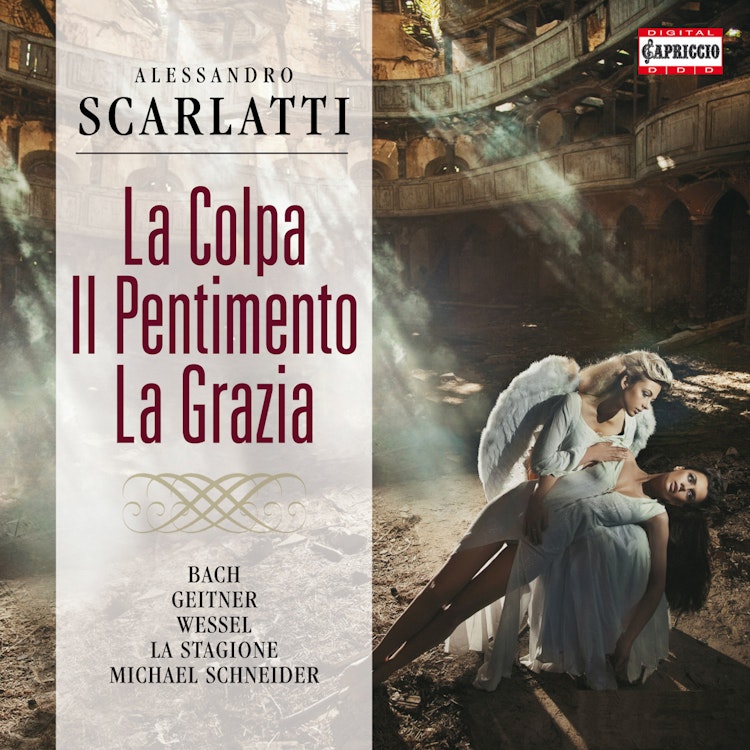
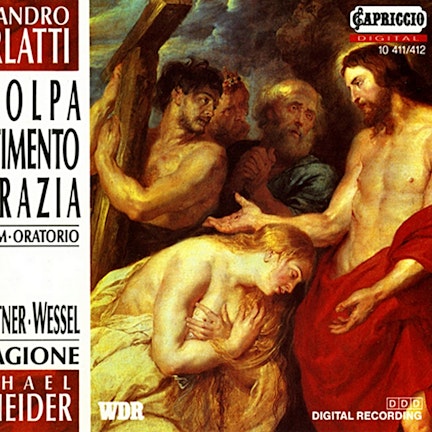
The libretto for Scarlatti's oratorio was written by Cardinal Pietro Ottoboni, an influential Roman cardinal and patron of the arts, who had also seen his text set by two other composers in previous years.
Compositional Technique
Scarlatti's score frequently uses the instruction "segue subito," indicating that he conceived the oratorio's many short sections as large, continuously flowing blocks.
Composer Biography
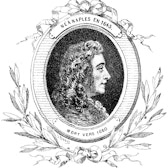
Alessandro Scarlatti, the composer of this oratorio, was one of the most versatile Baroque composers, with a vast output including operas, oratorios, serenades, and chamber music, despite being overshadowed by his son Domenico Scarlatti.
Compositional Technique
In the second part of the oratorio, Scarlatti creates an impressive vision of the Last Judgment, with four trumpets and a trombone joining the string orchestra and the voice of "Guilt" from different parts of the hall.
Compositional Technique
Scarlatti's oratorio features a unique musical setting of Jeremiah's Lamentations in Italian, rather than the customary Latin, with an elaborate orchestral accompaniment that uses flowing transitions and bold harmonies.
Composition History
Alessandro Scarlatti's oratorio, "La Colpa, il Pentimento, la Grazia," was premiered in Rome in 1708, just four days before Handel's "La Resurrezione," creating a silent contest between the two composers.
Compositional Technique
Scarlatti's oratorio demonstrates a sophisticated use of tonality, employing all 24 keys of the circle of fifths and assigning them to specific expressive areas, such as B-flat minor for lamentations and F-sharp minor for the cross.
You might also enjoy...
Scarlatti: Oratorio per la Passione di Nostro Signore Gesu Cristo - Stradella: Lamentatione per il Mercodi Santo
Trionfi! A Florentine Festival
Châteaux de la Loire: French Renaissance Court music
Clérambault: Motets à trois voix d'hommes et symphonies
Rejoice. Kay Johannsen: Vocal Music
Johannsen: Rejoice
Friedens-Seufftzer Und Jubel-Geschrey: Music for the Peace of Westphalia 1648
Villon to Rabelais - 16th Century Music of the Streets, Theatres, and Courts
Gottfried August Homilius: Musik an der Dresdner Frauenkirche. Jubiläumsedition
Music at the Frauenkirche Dresden (Anniversary Edition)
Musick For Severall Friends - 17th Century English Theatre Music