The composition of intavolations (organ transcriptions of motets) was an important task for Hamburg organists, as the city's single choir rotated among four main churches, requiring organists to perform these liturgical pieces on three Sundays a month.
Composer Biography
Heinrich Scheidemann trained with the famous organ teacher Jan Pieterszoon Sweelinck in Amsterdam, a study made possible by a stipend from St. Katharina's Church in Hamburg.
Compositional Technique
Heinrich Scheidemann established the chorale fantasia genre, where chorale phrases are freely elaborated with figurative solos, echo effects, and rapid manual changes, sometimes obscuring the original melody.
Composer Biography
Heinrich Scheidemann, born around 1595, inherited his father's post as organist at St. Katharina's Church in Hamburg and remained there for nearly forty years until his death in 1663.
Instruments
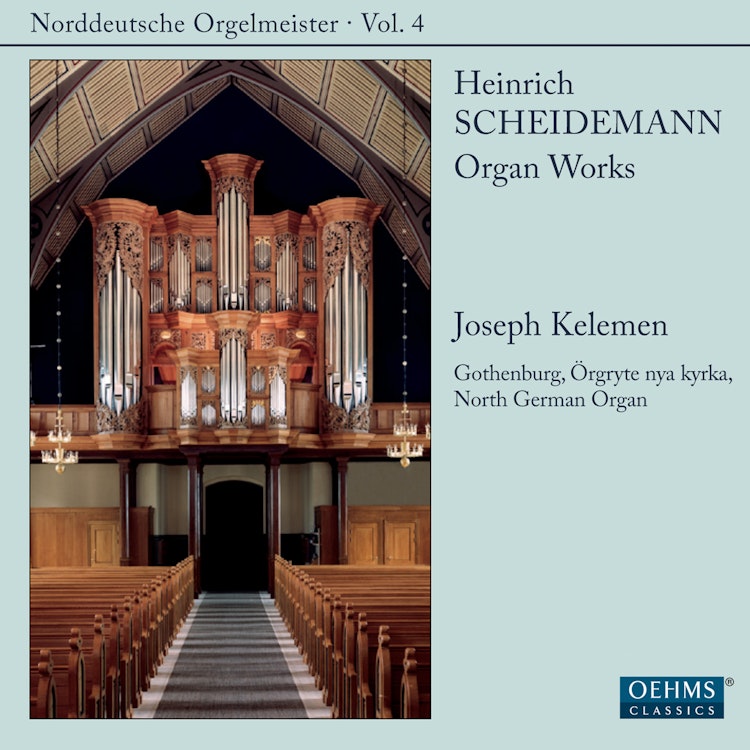
The organ used for this recording, the North German Organ 7 in Gothenburg, is the only four-manual instrument of its size tuned in mean-tone, a common tuning system from 1480-1630.
Recording & Production
The North German Organ 7 in Gothenburg was built as part of an interdisciplinary research project involving a team from twelve nations over ten years, aiming to recreate an organ type found in major North German churches around 1600.
Composer's Artistic Vision
Music theoretician Johann Mattheson described Heinrich Scheidemann as 'friendlier and more affable' than his colleague Jacob Praetorius the Younger, with playing that was 'swift with the fist; lively and cheerful'.
You might also enjoy...
Bruhns & Scheidemann: Organ Works
German Organ Music, Vol. 2
Tudor Organ Music
Opus 190
G. Silbermann Orgel der Petrikirche in Freiberg
Fantasy on Carlisle
Town Hall Organ Classics
Music for Christmas: James Welch in Concert at Stanford Memorial Church