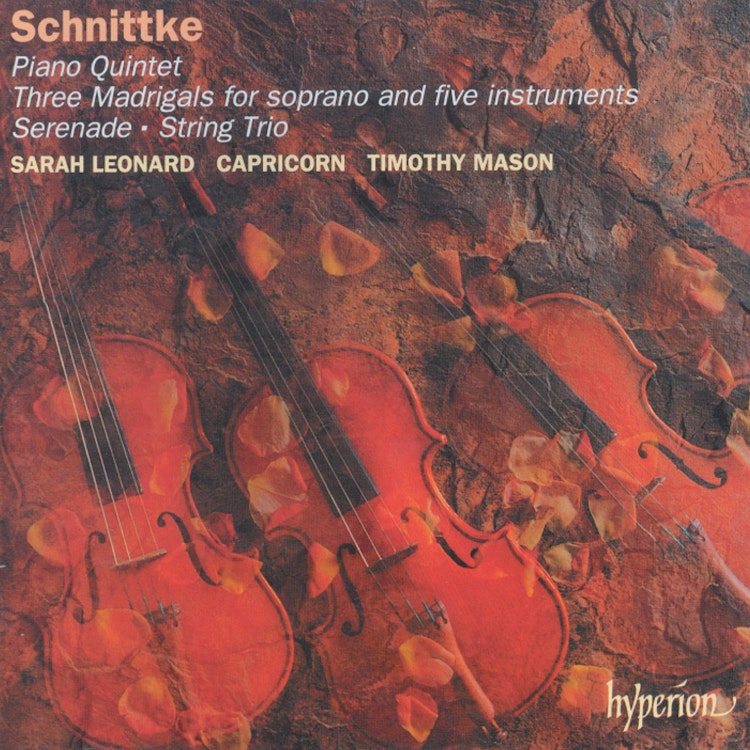
Capricorn, the ensemble on this recording, was formed in 1973 and is known for its committed playing of a wide repertoire, including premiering many new works.
Composer Biography
Alfred Schnittke, born in 1934 in Engels on the Volga River, came from a German-speaking family in a region settled by German colonists under Catherine the Great.
Compositional Technique
Schnittke often created 'double' works, where pieces like the Piano Quintet and String Trio (both on this album) also exist in later orchestral versions.
Composer's Artistic Vision
Alfred Schnittke is considered one of the most significant Russian composers of his generation since Shostakovich, with a wide and growing audience both in Russia and abroad.
Historical Context
During the late 1950s, a period of de-Stalinization under Khrushchev, there was a slight loosening of aesthetic restrictions in Russia, allowing composers like Schnittke to explore new musical ideas.
Composition History
Schnittke's String Trio was commissioned by the Alban-Berg-Gesellschaft to commemorate the centenary of the birth of Alban Berg, an Austrian composer known for his atonal and twelve-tone music.
Composer Biography
Schnittke's family moved to Vienna in 1946 after World War II, a "fateful move" that allowed the eleven-year-old to seriously pursue his musical interests.
You might also enjoy...
Louie, A.: Music for a Thousand Autumns
Carolan's Harp
Xtended Hearts and Unheard Herds
Turning Points
Elegy
Zuidam: McGonagall-Lieder
Dvořák: Concerto for Cello & Orchestra, etc
On The Road
Stanisław Radwan: Theater & Film Music
25 Miniatures
Viola Da Gamba Recital: Pandolfo, Paolo - Ortiz, D. / Corkine, W. / Hume, T. / Sumarte, R. / Machy, S. / Marais, M. / Bach, J.S.