Schnittke stated about the Concerto for Mixed Chorus: 'I wrote music which was evoked by this text, but not the music I wanted to write,' indicating his deep responsiveness to the text.
Composition History
Voices of Nature (Golosa prirodi, 1972) was originally an episode from the music for the documentary 'And Yet I Believe' by Mikhail Romm, accompanying dreamlike scenes of nature.
Compositional Technique
The musical language of the Concerto for Mixed Chorus is extremely simple, based on traditional harmony and familiar melodic formulae of Russian Orthodox music, yet it contains typical elements of Schnittke's personal style.
Composition History
Schnittke's Concerto for Mixed Chorus (1984/5) is based on the third chapter of 'The Book of Lamentations' by the Armenian monk Grigor Narekatsi (951-1003).
Historical Context
Schnittke's strong interest in God and religion, a subject important to the Russian intelligentsia, was forbidden during Soviet times and often raised as a protest against communist ideology.
Compositional Technique
Minnesang (1980-81) was written for 52 voices, with Schnittke specifically instructing singers to be dispersed on and around the stage, or to perform the piece outside a concert hall.
Composer Biography
Alfred Schnittke, a deeply respected composer, unexpectedly shifted from radical avant-garde to a more conventional and simplified musical style in the early 1970s.
You might also enjoy...
Bortniansky: Sacred Concertos, Vol. 1
Choral Concert: Stuttgart Chamber Choir - Daniel-Lesur, J.Y. / Ravel, M. / Debussy, C. / Fasch, C.F.C. / Schumann, R.
Hohes Lied
Kurtag: Choral Works
Hindemith: Mass, 12 Madrigals & 6 Songs on Old Texts
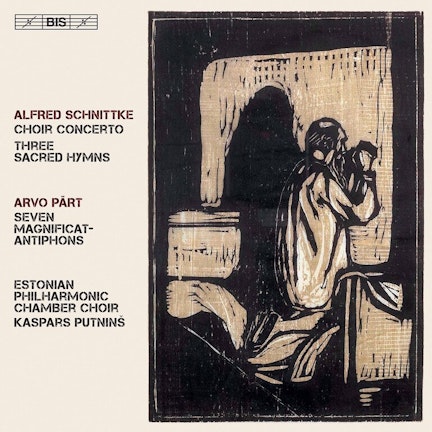
Schnittke & Pärt: Choral Works (2)
Pizzetti: Messa Di Requiem / Choral Compositions
Chansons Françaises
Eric Ericson Chamber Choir
Choral Music (French) - Absil, J. / Ravel, M. / Poulenc, F. / Hindemith, P.
Stanford: Partsongs
Vasks: Mate Saule / 3 Poems by Czeslaw Milosz
Scarlatti, D.: Stabat Mater / Ligeti, G.: Lux Aeterna / Boyd, A.: As I Crossed A Bridge of Dreams
Lux aeterna ... for 10-16 parts. Werke von Ligeti, Scarlatti, Boyd und Mahler