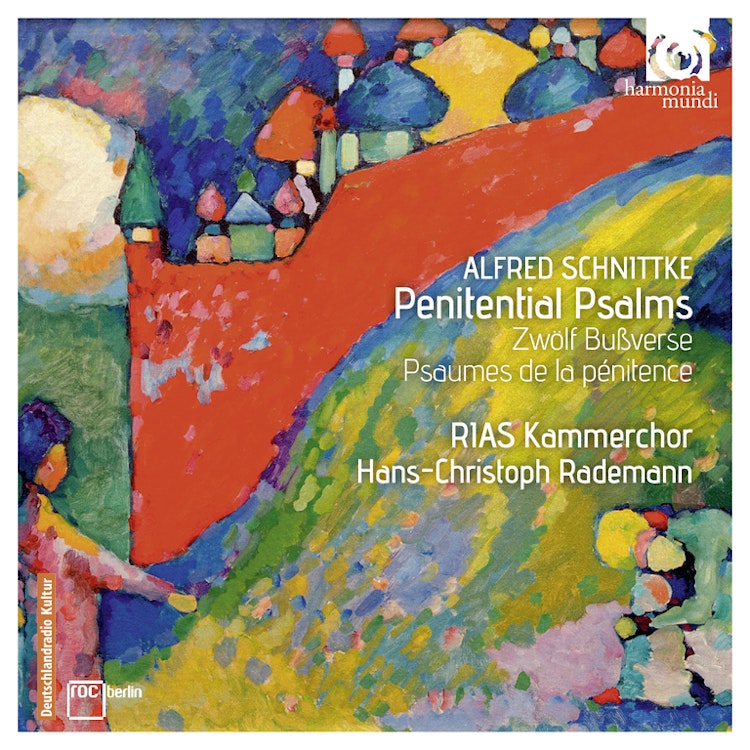
Schnittke's Penitential Psalms were composed in 1988 to commemorate the millennium of the Christianization of Russia, which began with the baptism of Grand Prince Vladimir.
Compositional Technique
Schnittke's Penitential Psalms feature a 'polystylistic' approach, incorporating a four-note B-A-C-H motif in the tenor part, signifying a connection to Bach's artistic independence.
Compositional Technique
The sixth verse of the Penitential Psalms contains the key to understanding the entire cycle, dealing with original sin and the murder of Vladimir's sons, Boris and Gleb.
Composer's Artistic Vision
Schnittke's 'polystylism' involved drawing on the vast material of music history, combining seemingly incompatible elements to create new, ambiguous connotations.
Recording & Production
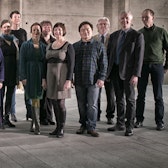
For this recording, the RIAS Kammerchor used Schnittke's autograph manuscript as a primary source, correcting errors and largely ignoring changes made in printed editions by Viktor Suslin, an editor.
Composer Biography
Alfred Schnittke, the composer, was born in 1934 in Engels, the capital of the former Volga German Soviet Republic, to a Catholic mother and a Jewish father of German descent, making him 'homeless' from the start.
Composer's Artistic Vision
Schnittke's musical training was influenced by the contrasting ideas of Arnold Schoenberg's circle and the music of Stravinsky, Prokofiev, and Shostakovich.