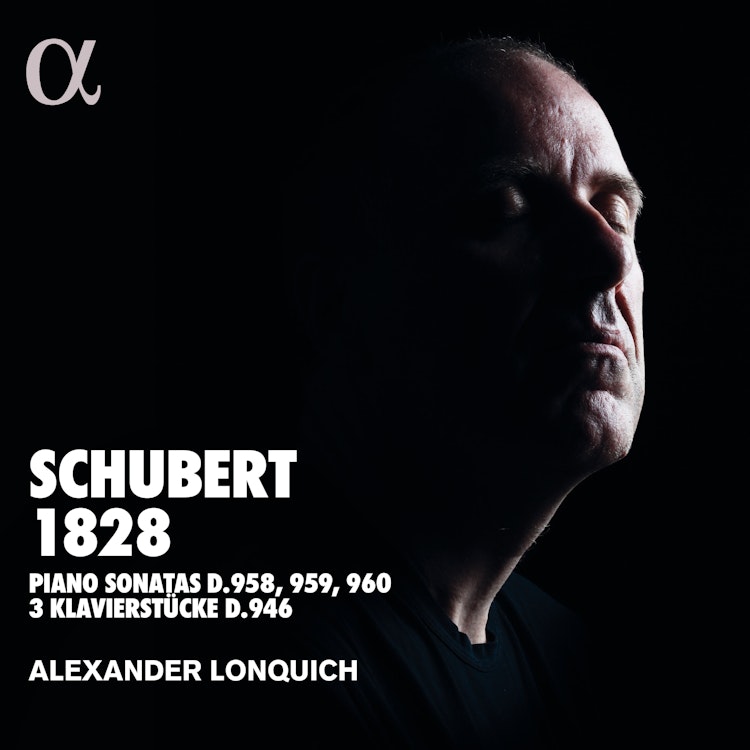
Quarterly Critics' Choice 1.2019 - German Record Critics' Award. The Naked Truth: Alexander Lonquich emphasises in his booklet text the "emphatically narrative character" of Schubert's last three sonatas. Yet he examines their structural complexity with Beethovenian rigour and a "naked" clarity and stringency, following the compositional process, rendering them a manifesto of visionary modernity. His fascinating attack, his perfect, flexible timing, a smooth pithiness and the dramatically sharpened narrative stream reveal the deep comfort- and hopelessness of these works with open vulnerability, and decisively refuse any trace of false sentimentality. This makes it captivating and shocking at the same time. (For the jury: Attila Csampai)
Featuring
Alexander Lonquich
Franz Schubert
Did you know?
1/7
Composition History
The last three piano sonatas and the String Quintet D956 were composed by Schubert in 1828, the year of his death, between May and September.
Compositional Technique
The second movement of Schubert's Sonata in A major D959 contains a B section that is described as 'unprecedented in the history of music' due to its chromaticisms and rhythmic accelerations.
Composer's Artistic Vision
Schubert's sonata form evolved to have an increasingly epic character, leading to the interpretation of these piano works as three volumes of a single novel.
Compositional Technique
Schubert's Sonata in C minor D958 shares thematic elements with his song cycle 'Winterreise' (1827) and Beethoven's 'Thirty-two Variations in C minor'.
Compositional Technique
The last of Schubert's '3 Klavierstücke' D946 features a frenetic, syncopated gait rooted in Hungarian folk music.
Compositional Technique
The second movement of Schubert's Sonata in B flat major D960 shares melodic material with the Adagio of his String Quintet and echoes the song 'Der Lindenbaum' from 'Winterreise'.
Recording & Production
This album was recorded in February and March 2017 at Villa San Fermo, Lonigo, Italy, with Peter Laenger as the recording producer, editor, and mastering engineer.
You might also enjoy...
Paul Badura-Skoda Plays Franz Schubert
Franz Schubert 1828
Schubert: The Last Three Piano Sonatas
31
Schubert: Piano Sonatas Nos. 19-21 - 3 Klavierstucke