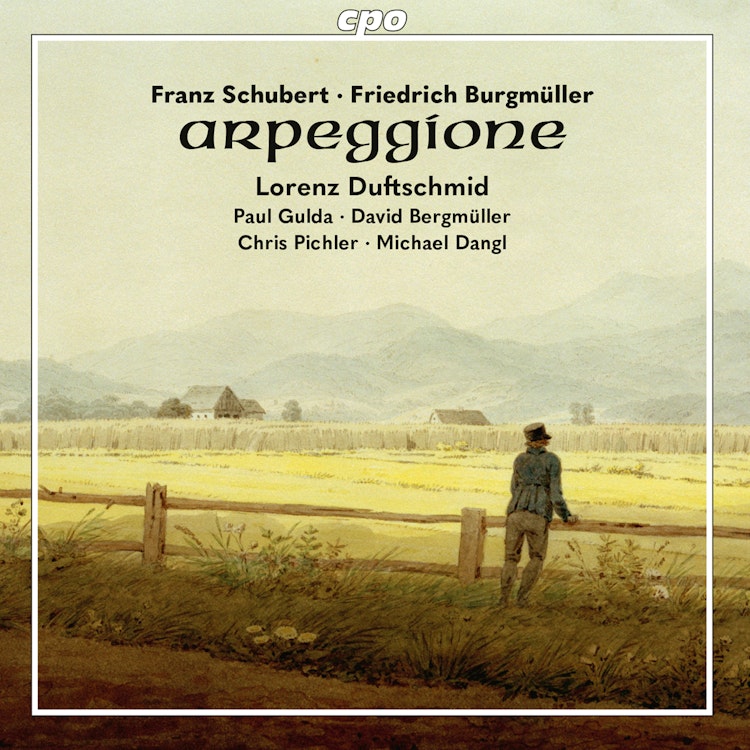
This recording uses an original pianoforte by Conrad Graf from 1824 and an original guitar by Georg Stauffer from 1803, the inventor of the Arpeggione.
Interpretation
Many of the sound effects Schubert intended for the Arpeggione Sonata are lost when played on modern cellos or violas due to their different tuning.
Composition History
Schubert's Arpeggione Sonata was composed in November 1824, but its first edition was only published in January 1871, more than 40 years later.
Composer Biography
Friedrich Burgmüller, whose Nocturnes are featured on this album, was the brother of Norbert Burgmüller, a composer admired by Schumann, and he pursued a more popular musical style.
Compositional Technique
The Arpeggione's harp-like broken chords, or 'arpeggios,' were a special quality that likely attracted Schubert, as they produced a pure and full sound.
Instruments
The Arpeggione combined guitar fingerings with a cello bow, and its frets made good intonation easier for the musician.
Instruments
The Arpeggione, a string instrument for which Schubert wrote his sonata, was invented by Viennese instrument maker Georg Stauffer and was popular for about a decade before disappearing.
You might also enjoy...
Two American Virtuosi: Carol Wincenc & Eliot Fisk
Da UNO A CINQUE
Debussy / Ravel / Bax
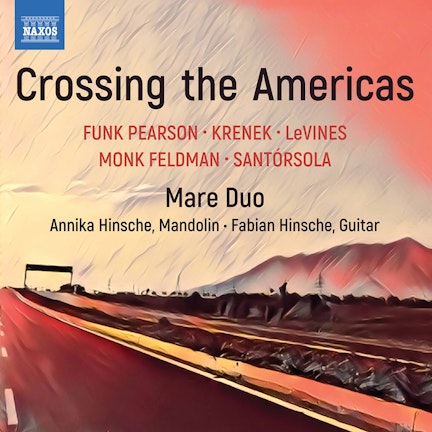
Crossing the Americas
Romance
Villa-Lobos: Chamber Music
Or. Couperin & Vivaldi
Orgelpunkt: Glocke Bremen, Vol. 2
La Rue: Missa De Feria & Missa Sancta Dei genitrix
Arpeggione - A Forgotten Instrument
American Music For Mandolin And Guitar
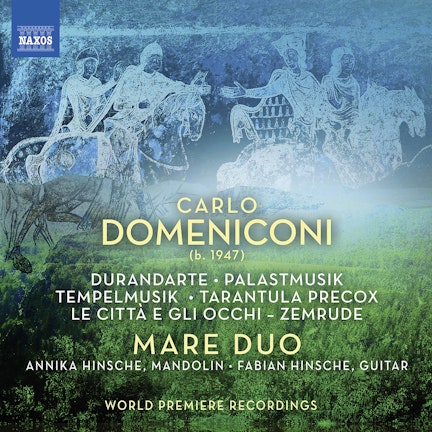
Carlo Domeniconi: Works for Mandolin & Guitar
Jubilissimo
Yun: Concertino / Duo / Intermezzo / Pezzo fantasioso