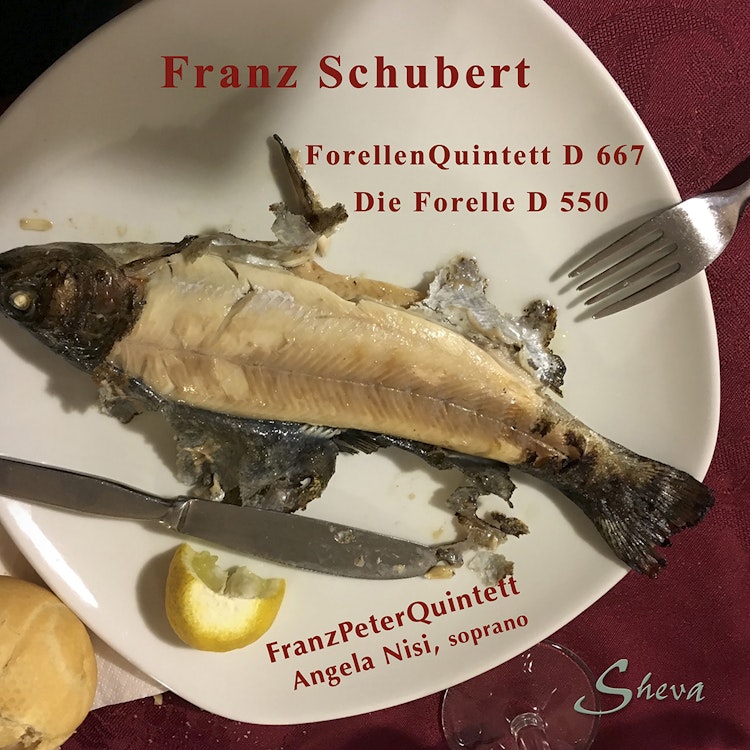
Schubert: Die Forelle, D. 550 "The Trout" & Piano Quintet in A Major, Op. Posth. 114, D. 667 "Trout"
7/1/2022, 6 Tracks, 43:58
Featuring
Angela Nisi
Marco Albrizio
Paolo Franchesini
Mizuho Ueyama
Gianluca Pirisi
Stefano Corato
Franz Peter Quintet
Franz Schubert
Did you know?
1/6
Composer's Artistic Vision
Schubert's "Trout Quintet" is characterized by a mutable virtuosity and a "capriciousness" that moves away from the rigor of Enlightenment-era music.
Composition History
Schubert's Piano Quintet in A major, D. 667, known as the "Trout Quintet," was commissioned by Sylvester Paumgartner, a wealthy mine owner and amateur cellist.
Compositional Technique
The Quintet's structure, with its five movements, does not alter the classical configuration of this type of composition, but rather fills canonical forms with a proliferation of ideas.
Compositional Technique
Schubert included the double bass in the "Trout Quintet" to add sonic depth and a "Leonardesque shadowiness," making the work more complete and universal.
Composition History
The commissioner, Sylvester Paumgartner, specifically requested that Schubert include a movement in variation form based on his Lied "Die Forelle" (The Trout), D. 550.
Compositional Technique
The "Trout Quintet" features an unusual instrumentation of piano, violin, viola, cello, and double bass, rather than the standard two violins, viola, and cello of a string quartet.
You might also enjoy...
Mozart: String Quintets Nos. 5 & 6
Mozart: Complete String Quintets, Vol. 1
Mozart: String Quintets Nos. 5 & 6
Mozart: String Quintets, K. 593 & K. 614
Schubert - Trout Quintet
Schubert - Trout Quintet
Schubert: Piano Quintet in A Major, Op. 114, D. 667 "The Trout"
Mozart: String Quintets, K. 406 and K. 516
Schubert: Quintet in C Major, Op. 161
Mozart: Complete String Quintets, Vol. 2
Franz Schubert: Piano Quintet in A major, D667 "The Trout" - "Forellenquintett" | Hans Richter-Haaser. Heribert Lauer. Hans Dusoswa. Mischa Frey. Rudolf Frei