The manuscript for Schubert's Quartet was found in 1918 in the attic of a farmhouse in Zell am See, belonging to a family whose great-uncle was a friend of the composer.
Composition History
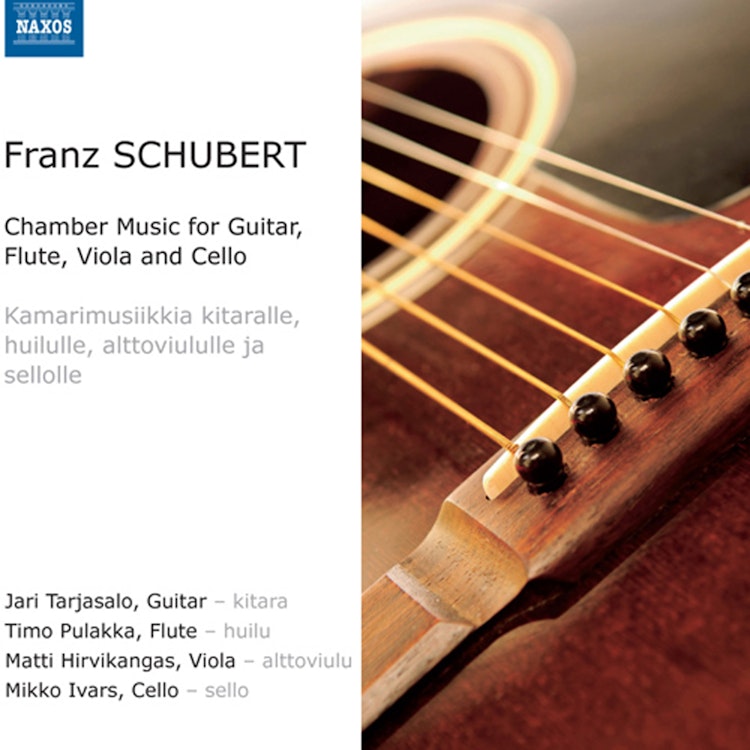
Franz Schubert's Quartet for flute, guitar, viola, and cello is an arrangement of Wenzel Matiegka's Trio for flute, viola, and guitar, with Schubert adding a cello part and composing a new trio for the minuet.
Historical Context
In the 19th century, arranging musical works for different instruments was very common, especially for spreading music to a wider audience before modern recording technologies.
Instruments
The 'Arpeggione' Sonata was composed for the arpeggione, a short-lived instrument invented in Vienna in 1823 by J. G. Stauffer, which resembled a guitar but was played with a bow like a cello.
Composition History
Schubert composed his 'Arpeggione' Sonata for the arpeggione, and it remains the only notable composition for this instrument.
Compositional Technique
The arrangement of the 'Arpeggione' Sonata on this album is historically interesting because the arpeggione part is played by the flute, and the original piano part is played by the classical guitar.
Composer Biography
Johann Kaspar Merz (1806-1856), who arranged six of Schubert's Lieder for solo guitar, lived in Vienna and was inspired by other compositions to create many arrangements and original works for guitar.