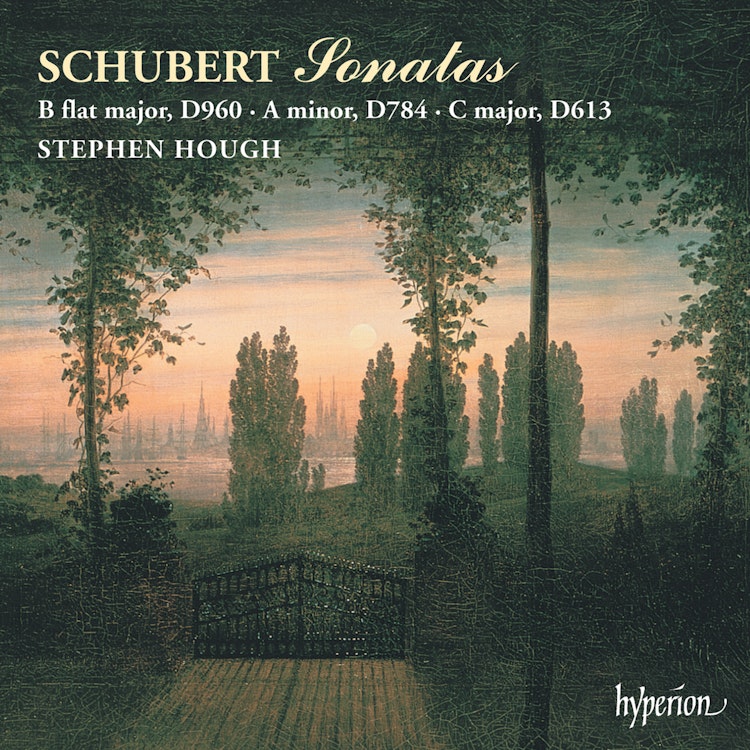
Schubert: Piano Sonata in B-Flat Major, D. 960; in A Minor, D. 784; in C Major, D. 613
9/15/2023, 9 Tracks, 1:16:09
Featuring
Stephen Hough
Franz Schubert
Did you know?
1/7
Performer Biography
Stephen Hough, the pianist on this recording, was honored with a MacArthur Foundation Fellowship in 2001 for his originality and commitment to advancing knowledge.
Interpretation
The nine first-time bars (117-125) in the opening movement of the Sonata in B flat major have often been omitted by pianists, but Stephen Hough includes them, believing they are important.
Recording & Production
This recording presents Schubert's unfinished sonata fragments exactly as he left them, which the performer suggests is a metaphor for the composer's unfinished life.
Composition History
Schubert left many piano sonata fragments, ranging from nearly complete movements to mere sketches, some abandoned due to lack of inspiration or because they became too complex.
Composer Biography
Schubert, like Beethoven, suffered from a serious, debilitating physical ailment; Schubert had syphilis, while Beethoven experienced hearing loss.
Composition History
The Sonata in A minor, D784, was likely written around the time Schubert first learned of the seriousness of his illness.
Compositional Technique
Schubert's ability to transform the sunshine of a major key into a mood of heartbreak and pain is a notable aspect of his work, perhaps only equaled by Mozart.
You might also enjoy...
Schubert: Piano Sonatas I
Schubert: Piano Sonatas Nos.15 & 18
Schubert Sonatas
Schubert: Piano Sonatas; Impromptus
Schubert: Piano Sonata in G Major, Op. 78, D. 894 "Fantasie"
Schubert: Piano Sonata No. 14
Schubert: Sonates pour piano
Schubert: Piano Sonata No. 21 in B-Flat, D. 960
Schubert: Piano Sonata in B-flat Major, D 960
The Koroliov Series, Vol. 15: Schubert – Piano Sonatas, D. 894 & 959