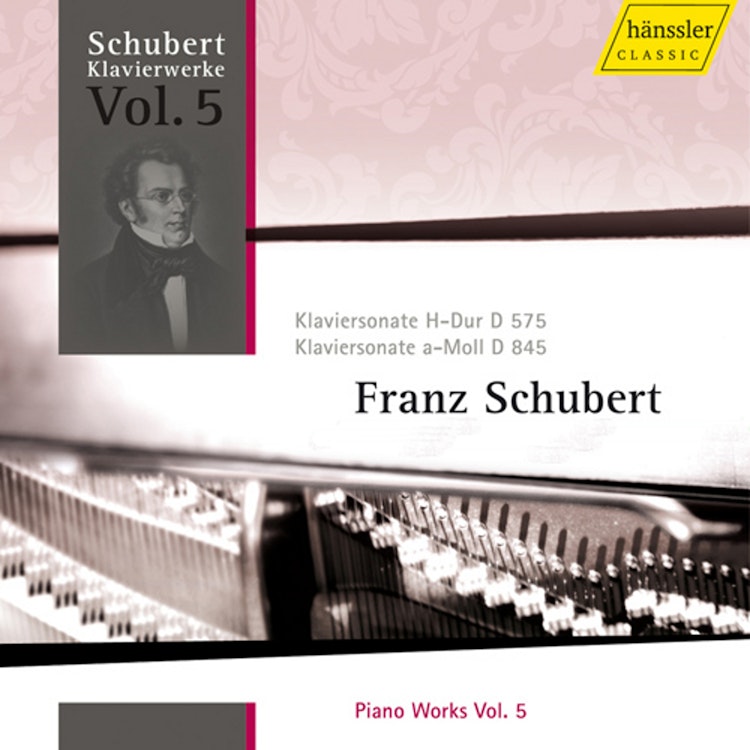
When Franz Schubert composed his first piano sonata in 1815, the four-movement sonata form had already reached its full development, with all of Mozart's and Haydn's piano works available and 27 of Beethoven's sonatas published.
Composition History
The Sonata in B major D 575, from Schubert's prolific 'sonata year' of 1817, was preserved thanks to his youthful friend Albert Stadler, who copied it for pianist Josefine von Koller before the original manuscript was lost.
Performer Biography
Gerhard Oppitz, the pianist on this recording, won first prize at the Arthur Rubinstein Competition in Israel in 1977, marking the start of his worldwide concert career.
Critical Reception
A 1826 review in the Leipzig Allgemeine Musikalische Zeitung compared Schubert's A minor sonata to Beethoven's greatest sonatas and noted its imaginative, free, and bold character.
Composer's Artistic Vision
Franz Schubert's piano sonatas are considered some of the most illustrious and prized pieces for the instrument, characterized by a song-like style where a fine-spun melody unfolds over a smoothly flowing accompaniment.
Composition History
Schubert dedicated his A minor sonata to Archduke Rudolph, a patron and pupil of Beethoven, which demonstrated the composer's new self-assurance.
Composer Biography
Although not a virtuoso, Schubert was an accomplished pianist; after performing his first published sonata, he wrote to his parents that some assured him the keys 'began to sing under my fingers'.
You might also enjoy...
Schubert: Piano Sonata No. 6 in E Minor, D. 566: I. Moderato
Schubert
Schubert: Piano Works, Vol. 2
Schubert: Piano Sonatas Vol. I
Schubert: The Three Posthumous Sonatas
Schubert: Piano Sonatas, D. 157, 537 & 566
Schubert: Piano Sonatas Nos. 16 & 21
Schubert: Piano Sonatas Nos. 4 & 9
Schubert: Piano Sonata No. 13 in A Major, D 664 (Op. posth. 120) [Concours Géza Anda 2024, Live]
Schubert: Piano Sonatas, D. 958 & 960
Schubert, F.: Piano Sonatas, D. 845, 850
Schubert: The Complete Sonatas and Major Piano Works, Volume 3 - The Power of Fate
SCHUBERT: Piano Sonatas, D. 959 and D. 840, 'Reliquie'
Schubert: Piano Sonata in D Major, D. 850, Op. 53 "Gasteiner"