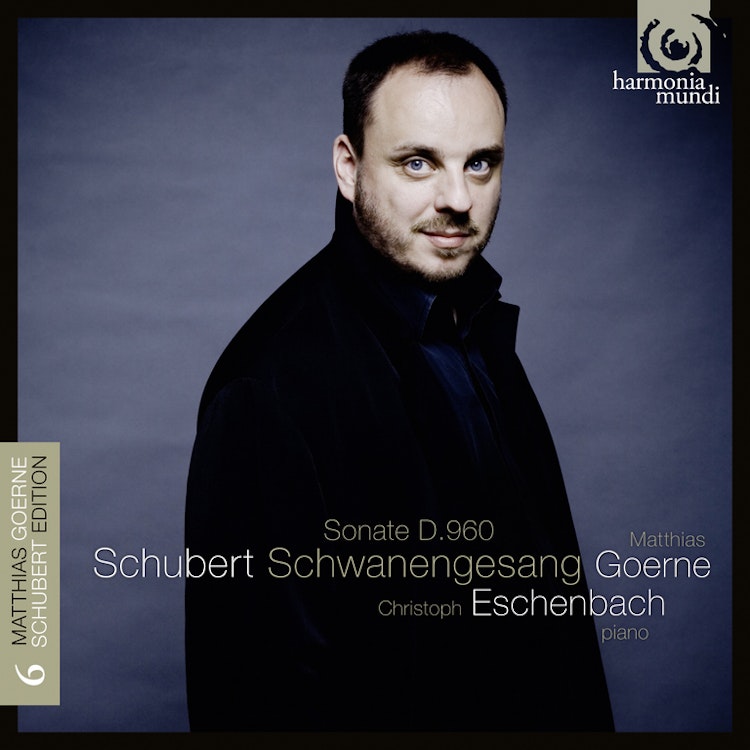
Schubert: Schwanengesang D. 957 - Piano Sonata D. 960
4/17/2012, 19 Tracks, 1:50:45
Featuring
Matthias Goerne
Christoph Eschenbach
Franz Schubert
Did you know?
1/7
Critical Reception
Schubert's last piano sonatas, published in 1839 and dedicated to Robert Schumann, were largely ignored in the 19th century and only gained their current recognition in the 20th century.
Compositional Technique
In his final piano sonatas, Schubert uses a "sinister trill" that repeatedly interrupts the main theme, creating a sense of being lost in a labyrinth, unlike Beethoven's approach to triumph over form.
Composer's Artistic Vision
Schubert was deeply affected by the "darkness and cruelty, the unsentimental despair" of Heinrich Heine's poems, which he discovered at a reading party.
Composition History
Schwanengesang (Swansong) is a collection of 14 lieder assembled by Schubert's brother Ferdinand and publisher Haslinger after the composer's death, not a cycle comparable to his earlier ones.
Composer Biography
Schubert learned of Ludwig van Beethoven's death while composing the first book of Winterreise, an event that left him in despair but also spurred him to work.
Composition History
Schubert composed an "unreal harvest of masterpieces" in 1828, the year he died, including the two piano trios, Impromptus, Mass in E flat, Quintet for two cellos, and his last three piano sonatas.
Composition History
The poems by Ludwig Rellstab (1799-1860) used in Schwanengesang were originally sent to Beethoven, who marked his favorites, but he died before setting them to music.