Schubert: String Quintet in C Major, D. 956; Quartettsatz, D. 703
11/10/2023, 5 Tracks, 1:03:41
Featuring
Edward Dusinberre
Károly Schranz
Geraldine Walther
Ralph Henry Kirshbaum
András Fejér
Takács Quartet
Franz Schubert
Did you know?
1/7
Compositional Technique
Schubert's String Quintet adds a second cello, unlike Mozart's quintets which add a second viola, to exploit the warm sound of combined cellos, a technique also used by Boccherini.
Critical Reception
The 'Quartettsatz' D703 was first published in 1870, over 40 years after Schubert's death, and its fragmentary slow movement appeared in print in 1897, with the editorial board (including Brahms) valuing it similarly to the 'Unfinished Symphony'.
Instruments
Ralph Kirshbaum, the guest cellist on this recording, plays a rare Montagnana cello that once belonged to the 19th-century virtuoso Piatti.
Composition History
Schubert's String Quintet, described as 'perhaps the most hauntingly beautiful of all Schubert's chamber works', remained forgotten until 1850 when the Hellmesberger Quartet championed it, three years before its publication.
Performer Biography
The Takács Quartet was formed in 1975 at the Franz Liszt Academy in Budapest by four students, and two of the original members, Károly Schranz and András Fejér, remain in the current ensemble.
Composition History
Schubert's 'Quartettsatz' D703, a string quartet movement, was left unfinished after only 40 bars of a slow movement were composed, possibly due to his dissatisfaction with its unorthodox form.
Composer Biography
Schubert died at the age of 31, six weeks after writing to a publisher about his new compositions, including the String Quintet, none of which he saw in print during his lifetime.
You might also enjoy...
Schubert: Trout Quintet / String Quartet in D minor "Death and the Maiden"
Schubert: "Trout" Quintet; String Quartet No.14 ("Death and the Maiden")
Schubert: Trout Quintet; Death and the Maiden Quartet
Schubert Trout Quintet, Death and the Maiden Quartet
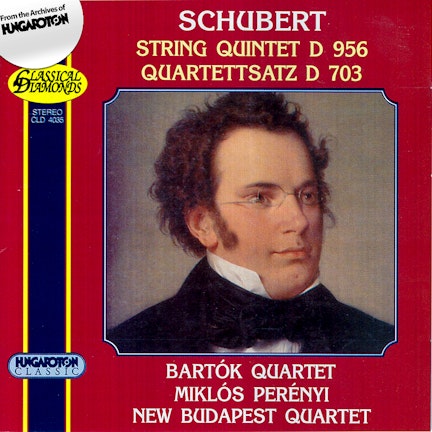
Schubert: String Quintet; Quartettsatz
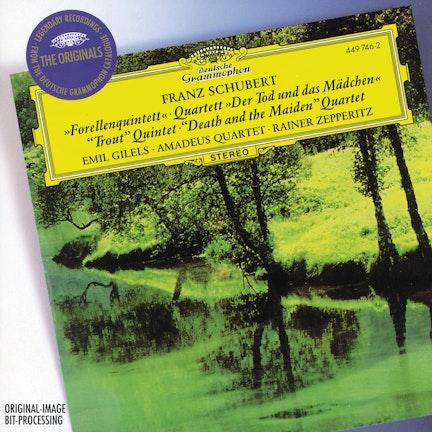
Schubert: "Forellenquintett", Streichquartett "Der Tod und das Mädchen"
Schubert: String Quintet in C Major, D. 956 / String Quartet No. 12 in C Minor, "Quartettsatz"
Schubert: String Quintet & String Quartet 'Death and the Maiden'
Schubert: Piano Quintet "The Trout"; String Quartet "Death and the Maiden"
Schubert: Piano Quintet in A Major, Op. 114, D. 667 "Trout" & String Quartet No. 13 in A Minor, Op. 29, D. 804 "Rosamunde"
Schubert: String Quartets (Complete), Vol. 7
Schubert: Piano Quintet in A Major, D.667 - Mozart: Serenade No. 13 in G Major, K. 525 "Eine kleine Nachtmusik"