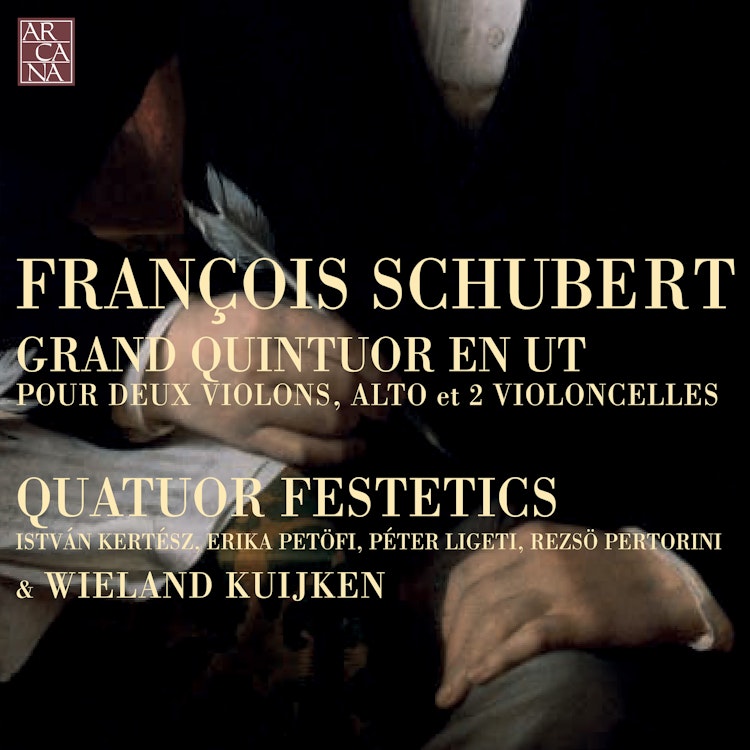
Schubert: String Quintet in C Major, Op. 163, D. 956
4/28/2017, 4 Tracks, 53:02
Featuring
Wieland Kuijken
István Kertész
Erika Petőfi
Péter Ligeti
Rezső Pertorini
Festetics String Quartet
Franz Schubert
Did you know?
1/6
Critical Reception
Despite being published in 1853, 25 years after Schubert's death, the Quintet did not immediately find success; Joseph Joachim, a friend of Brahms, found it "disproportionate and lacking in a sense of beauty of contrasts."
Recording & Production
This recording was made in Budapest at the Library of Techniques from October 5 to 8, 2000, produced by Michel Bernstein.
Composition History
Schubert's Quintet in C major, D 956, was likely completed before the composer moved in with his brother Ferdinand, as the original sketches and autograph manuscript were lost due to "incredible negligence of posterity" during the move.
Instruments
The performers on this recording use historical instruments, including a Milanese violin from the 18th century, a Viennese violin from 1770, a Bolzano viola from 1651, and a 17th-century French cello.
Composition History
The Quintet in C major was proposed by Schubert to his publisher Probst in a letter dated October 2, 1828, alongside his last three piano sonatas and Heine Lieder.
Critical Reception
The manuscript of Schubert's Quintet in C major remained untouched in the archives of Viennese publisher Spina for decades, causing Brahms great concern when he discovered it in 1862.