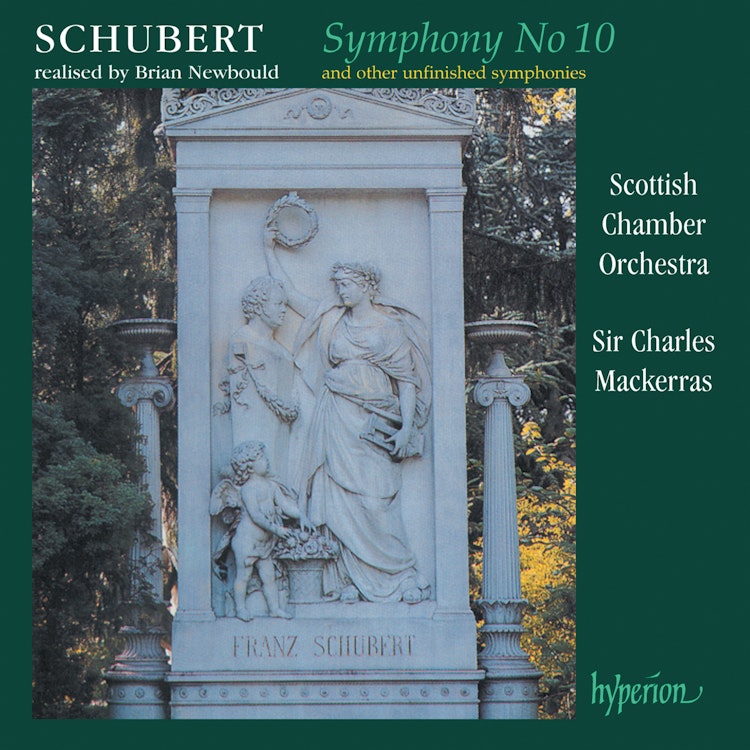
Schubert: Symphony No. 10 & Other Unfinished Symphonies
1/26/2024, 9 Tracks, 54:04
Featuring
Sir Charles Mackerras
Scottish Chamber Orchestra
Franz Schubert
Did you know?
1/7
Composition History
The 'Unfinished' Symphony (No. 8) is considered a 'finished half-symphony' because its two movements do not constitute a complete symphony, as it ends in a different key than it began.
Compositional Technique
Schubert's Symphony in D major D708A features a second subject in A flat, a tritone distant from the home key, which is the only known example of this in the entire Classical period.
Composer Biography
Schubert began thirteen symphonies but completed only seven, with his 'Great' C major Symphony (No. 9) being the only one finished in the last ten years of his life.
Compositional Technique
Schubert's 'Tenth' Symphony (D936A) requires an enlarged Romantic orchestra, including trombones, unlike his earlier symphonies and the D615 and D708A fragments which used a standard Classical ensemble.
Performer Biography
Brian Newbould, who realized these unfinished symphonies, is a Professor of Music, composer, and pianist, known for completing, editing, and transcribing works by Schubert.
Composer Biography
Schubert decided to take counterpoint lessons with Simon Sechter in his final weeks of life, but only lived to attend the first lesson on November 4, 1828.
Composition History
The folio of Schubert's sketches, initially thought to be for one symphony (D615), was later discovered to contain work on three different symphonies dating from 1818, 1821, and 1828.
You might also enjoy...
Brahms: Symphonies Nos. 1 & 2 / Strauss: Don Juan
Saint-Saëns: Symphonies, Vol. 2
Sibelius: Symphonies Nos.4-7; The Swan of Tuonela; Tapiola