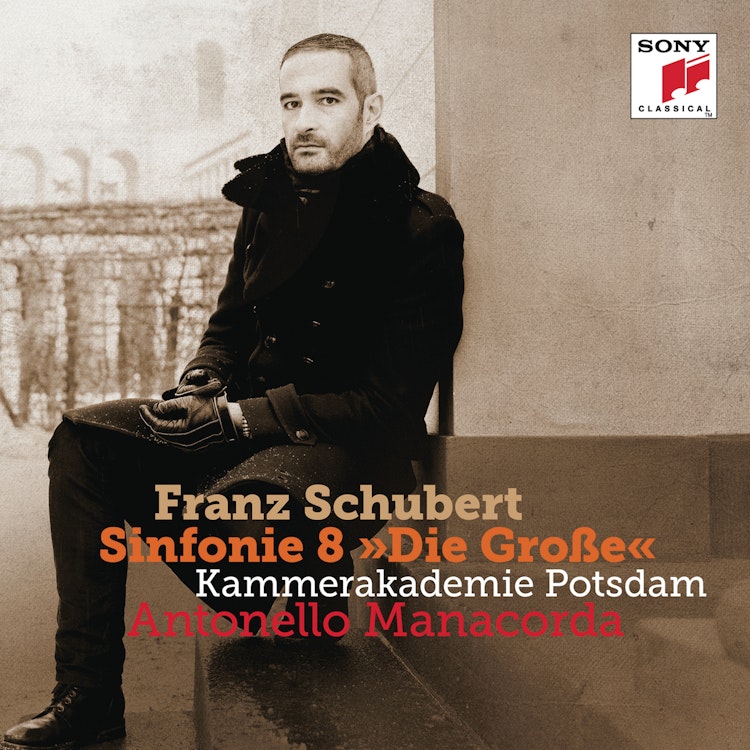
Antonello Manacorda, the conductor of this album, was a founding member of the Mahler Chamber Orchestra, serving as its Vice-President and Concertmaster for eight years before pursuing conducting.
Compositional Technique
Schubert's "Great C Major Symphony" achieves a rich sound and extreme economy of design, with themes in all movements developing from the basic c-d-e motif introduced in the opening.
Composition History
Schubert's Symphony No. 8, known as the "Great C Major Symphony," was completed in 1828 but was rejected by orchestra musicians as too long and difficult, so Schubert never heard it performed.
Notable Performances
The first performance of Schubert's "Great C Major Symphony" was arranged by Robert Schumann, who discovered the score, and was conducted by Felix Mendelssohn Bartholdy in Leipzig on March 21, 1839.
Compositional Technique
The symphony's opening features an unaccompanied horn melody, a novel element for its time, which is then carried by two horns in unison, suggesting a ceremonial call rather than a solitary one.
Compositional Technique
Schubert's orchestration in this work is forward-looking, especially his innovative and flexible use of three trombones, which are used melodically, chordally, and even as a bass for woodwinds.
Critical Reception
Robert Schumann famously praised Schubert's symphony, noting its "heavenly length" and rich musical technique, comparing it to a four-volume novel by Jean Paul.
You might also enjoy...
Schubert: Symphonies, Vol. 1 – Nos. 3, 5 & 8
Schubert: Symphonies Nos. 5 and 8, "Unfinished"
Schubert: Unfinished & The Great Symphonies
Schubert: Symphonies Nos. 3, 5 and 8
Schubert: Symphony No. 3 in D Major, D. 200
Schubert: Complete Symphonies
Schubert: Symphony No. 8 in C Major, D. 944 "Great"
Schubert: Sinfonien 2 & 4
Schubert: Symphony No. 8 in B Minor, D. 759 "Unfinished" (Live at Ozawa Hall, Boston, September 2007)