Schubert only discovered the remaining twelve poems of Wilhelm Müller's Winterreise in late summer 1827 and completed setting them to music by October of that year.
Composer's Artistic Vision
Schubert's Winterreise marks an evolution in his compositional style, moving from a more candid approach to a dramatic writing that expresses the idea of death through musical symbolism and ingenious piano effects.
Composition History
When Schubert began composing Winterreise in February 1827, he initially only knew the first 12 poems by Wilhelm Müller, setting them as a complete work without foreseeing a continuation.
Composition History
Schubert's Winterreise is his second lieder cycle, composed in 1827, following Die Schöne Müllerin and preceding the posthumously published Schwanengesang.
Recording & Production
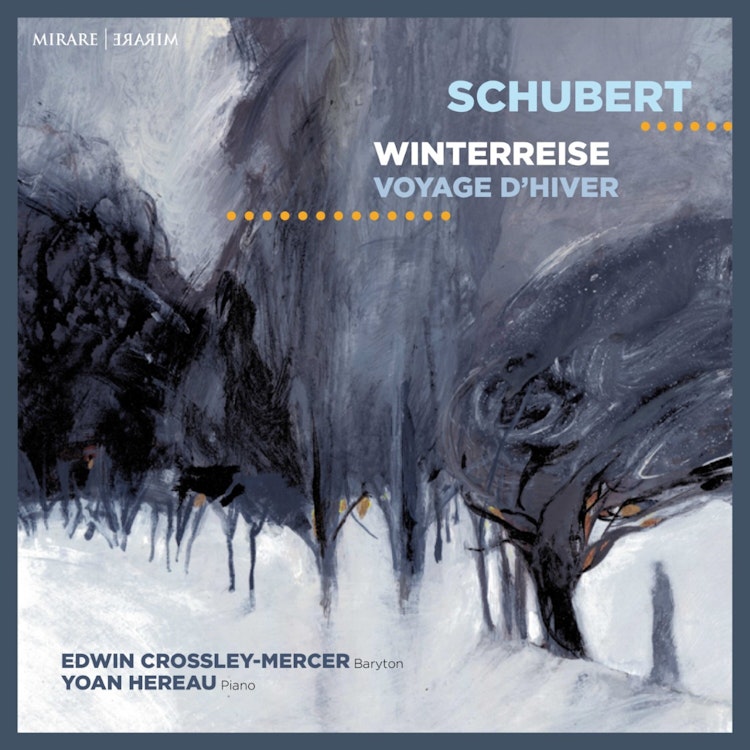
This recording of Schubert's Winterreise was made in Mons Arts de la scène (MARS) in Belgium, specifically in the large hall of Arsonic, between January 14 and 20, 2019.
Compositional Technique
In Winterreise, Schubert uses simple yet expressive musical devices, such as the minor mode to evoke cold winter or painful reality, and the major mode to represent happy memories.
Performer Biography
This album marks Edwin Crossley-Mercer's first recording dedicated to lieder, accompanied by pianist Yoan Héreau.