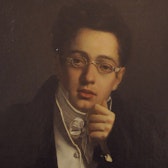
Schubert's song 'Der Wanderer' was immensely popular, earning its publisher 27,000 Gulden between 1821 and 1860, though the composer received none of this profit.
Historical Context
The song 'Der Wanderer' resonated with art-loving liberals in Metternich's Vienna, serving as a metaphor for their suppression after the Congress of Vienna.
Composer's Artistic Vision
Schubert gave 'Der Wanderer' a threefold title: 'The Wanderer or: The Stranger or: The Unfortunate', indicating it was more than just a song about nature.
Performer Biography
Alexander Hülshoff, the cellist on this recording, is also the artistic director of the Kloster Kamp chamber music festival and Villa Musica, a foundation in Rhineland-Palatinate.
Instruments
The Arpeggione, for which Schubert's sonata was written, was a now-forgotten instrument with six guitar-tuned strings and frets, played with a bow.
Composer Biography
Franz Schubert never wrote an original work for cello and piano, as his patrons who were cellists tended to commission larger chamber works rather than sonatas.
Composition History
The Arpeggione Sonata was written for Vinzenz Schuster, a popular arpeggionist in Vienna, in March 1824.
You might also enjoy...
Forgotten Romances
Tour de Paris
Recital for Cello & Piano
The Estonian Cello
Enescu: Complete Works for Cello & Piano
Alexander Buzlov. In Memory of Friend
Cello Sonatas of 1948
Busoni: Complete Works for Cello and Piano
Werke für Violoncello und Klavier
Shostakovich, Desyatnikov, Shchedrin, Schnittke
Piazzolla, Ustvolskaya, Schnittke: Works for Cello (Russia, 1996)