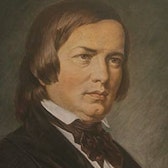
Schumann's Piano Concerto began as a single-movement Phantasie for piano and orchestra in 1841, which he later revised in 1845 by adding a slow movement and finale.
Composer Biography
Clara Wieck, Schumann's wife and a pianist, encouraged him to write for orchestra, believing his imagination was too great for only the piano.
Album & Artwork
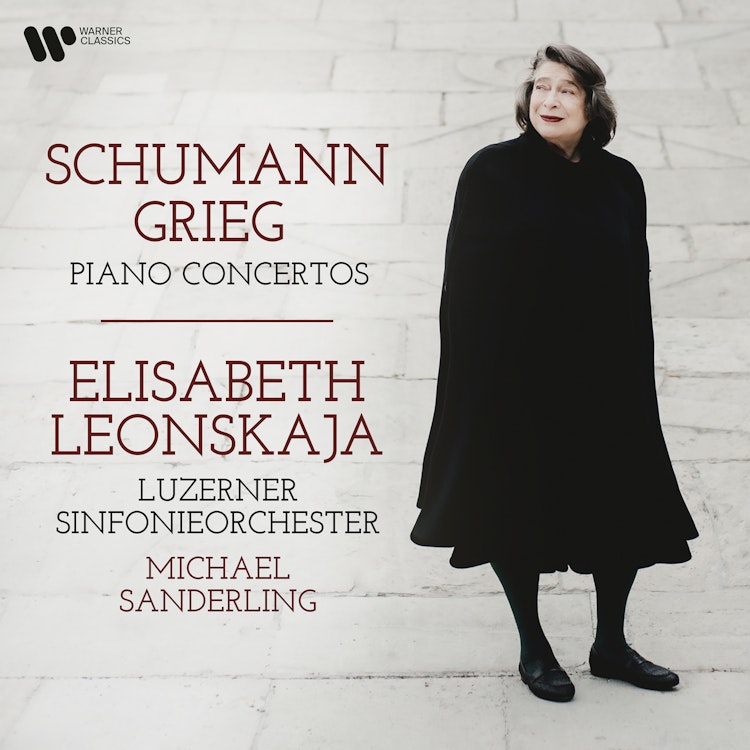
The pairing of Schumann's and Grieg's Piano Concertos on a single album originated with the advent of long-playing discs, with each work conveniently occupying its own LP side.
Notable Performances
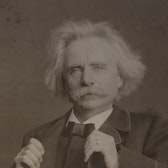
Edvard Grieg, a young music student at the time, was in the audience for a performance of Schumann's Piano Concerto in Leipzig, with Clara Schumann as the soloist.
Compositional Technique
Both Schumann's and Grieg's Piano Concertos are in A minor and share structural characteristics, including opening piano cadenzas with downward flourishes and lyrical second themes in C major.
Composition History
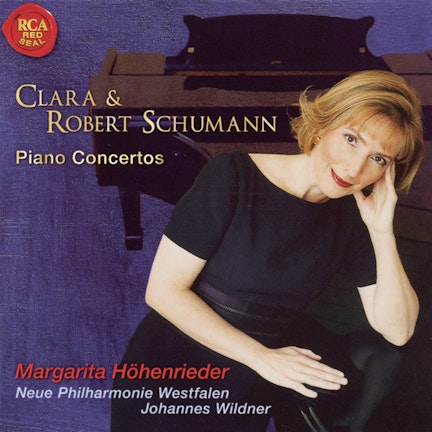
Traces of Clara Wieck's own youthful Concerto in A minor can be found in Robert Schumann's first movement, including a four-note motive from her third movement.
Composition History
Franz Liszt, a renowned composer and pianist, sight-read Grieg's Piano Concerto, playing both solo and orchestral parts simultaneously, and offered suggestions for changes.
You might also enjoy...
Clara Schumann, Robert Schumann: Klavierkonzerte
Brahms: Concerto No. 2 in B-flat Major for Piano and Orchestra, Op. 83
Grieg & Schumann: Piano Concertos
Brahms : Piano Concerto No.1 & Strauss, Richard : Burleske
Schumann / Grieg: Piano Concertos
Brahms: Piano Concerto No. 1
Brahms: Concerto No. 2 for Piano and Orchestra in B-Flat Major, Op. 83
Brahms: Piano Concertos
Clara Schumann, Robert Schumann: Klavierkonzerte
Grieg & Schumann: Piano Concertos
Grieg & Schumann: Piano Concertos
Schumann: Piano Concerto, Op. 54 - Strauss: Burleske
Brahms: Piano Concerto No.1
Brahms: Piano Concerto No. 2 / Schumann: Piano Concerto in A Minor