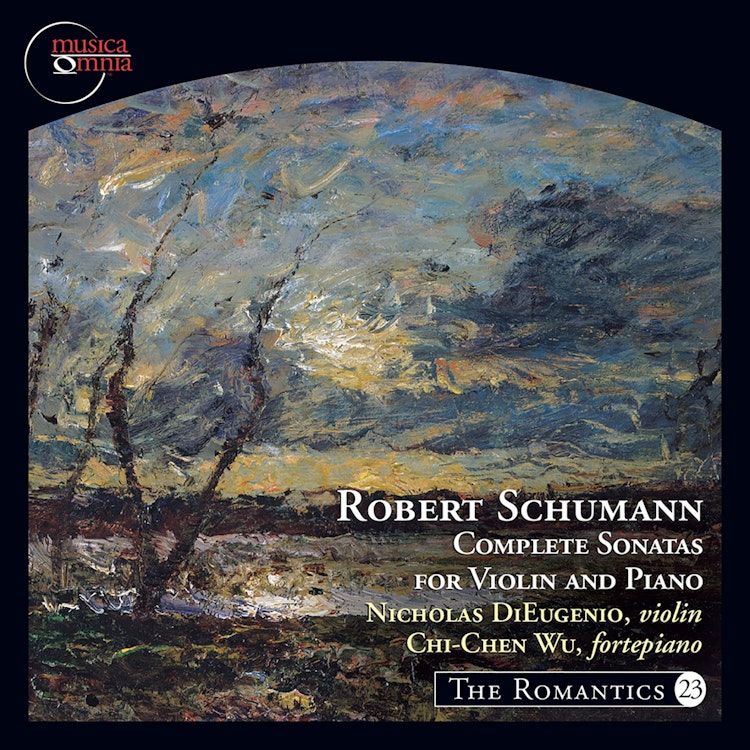
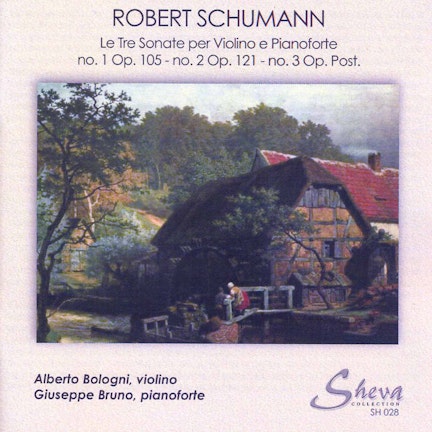
Schumann's third sonata was suppressed from publication by his wife Clara Schumann due to her apprehension about its weaknesses, and it only came to light with its publication in 1956.
Performer Biography
Nicholas DiEugenio, the violinist on this album, has been praised for his 'invigorating, silken' playing and 'mysterious atmosphere' by the Cleveland Plain Dealer.
Performer Biography
Chi-Chen Wu, the fortepianist, was praised by World Journal, Chicago for her 'amazing playing' and for making Schumann's music 'come to life in a new way'.
Composition History
The FAE sonata, which accounts for two movements of the third violin sonata, was written in honor of violinist Joseph Joachim and based on his personal slogan 'Frei aber einsam' (Free but alone).
Instruments
The fortepiano used in this recording is a 6½-octave instrument by R. J. Regier, based on designs by Graf and Bösendorfer.
Interpretation
This recording by Nicholas DiEugenio and Chi-Chen Wu is the first to present all three Schumann sonatas with a piano similar to Schumann's own instruments, which helps achieve a desirable balance with the violin.
Composition History
The third sonata has its origins in an unusual 1853 group composition by Albert Dietrich (a student of Schumann), Johannes Brahms, and Robert Schumann himself, written in honor of the violinist Joseph Joachim.
You might also enjoy...
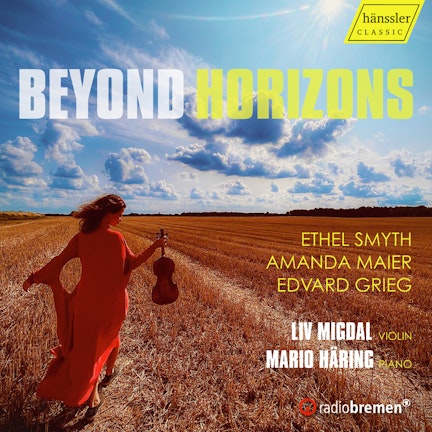
Beyond Horizons
Sonatas for Violin and Piano
Grieg: Violin Sonatas
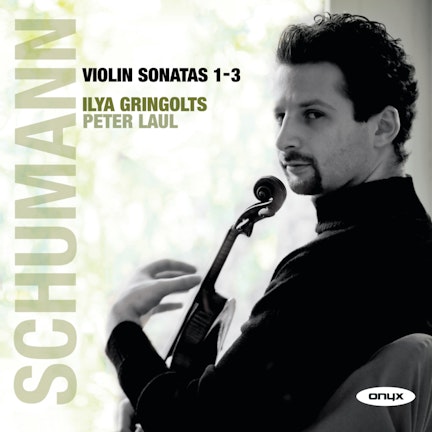
Schumann: Violin Sonatas 1-3
Franck & Lekeu: Violin Sonatas
Franck & Fauré: Violin Sonatas in A Major
Grieg, E.: Violin Sonatas Nos. 1-3
Schumann: 3 Sonatas for Violin & Piano
Franck: Violin Sonata No. 3 in C Minor - Grieg: Violin Sonata in A Major
Grieg: The Violin Sonatas
Fauré: Les deux sonates pour violon et piano, Op. 13 & 108
Brieuc Vourch, Guillaume Vincent; Richard Strauss, César Franck; Sonaten
Schumann, Brahms & Dietrich: F-A-E Sonata
Fuchs: Violin Sonatas Nos. 4-6
Fauré: Violin Sonata No. 1 in A Major, Op. 13 - Saint-Saëns: Violin Sonata No. 1 in D Minor, Op. 75 - Franck: Violin Sonata in A Major, FWV 8