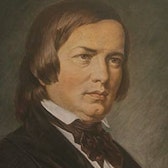
Schumann: Études symphoniques, Op. 13 - Études sur un thème de Beethoven, WoO 31 & Geistervariationen, WoO 24
9/24/2021, 40 Tracks, 1:08:45
Featuring
Claire Désert
Robert Schumann
Did you know?
1/7
Composition History
The theme for Schumann's 'Geistervariationen' (Ghost Variations) was believed by the composer to be from Schubert, but it was a reminiscence of his own Violin Concerto.
Composition History
Schumann's Symphonic Etudes, Op. 13, underwent several name changes, initially being called 'Variations pathétiques' before settling on 'Etudes en forme de variations'.
Compositional Technique
Schumann used variations to explore different perspectives on a single theme, likening it to viewing a landscape through variously colored stained-glass panes.
Composer's Artistic Vision
For Schumann, the variation genre was a means to achieve the absolute in pianistic writing, guided by his fleeting moods, and to capture daily life.
Composition History
The 'Studies on a theme by Beethoven' (composed in 1831 and assembled by musicologist Robert Münster in 1976) allowed Schumann to playfully engage with Beethoven's influence.
Composer's Artistic Vision
Schumann believed that music, like nature, is in a constant state of transformation, with variations serving as fragments of a greater whole.
Composer Biography
Schumann's final work, the 'Geistervariationen' (Ghost Variations), was composed shortly before his attempted suicide in the Rhine River in 1854, amidst auditory hallucinations.
You might also enjoy...
Schumann: Complete Piano Works, Vol. 14
Busoni: Piano Music, Vol. 2
Reicha: Rediscovered, Vol. 3
Arthur Honegger: Toccata et Variations, H.8
Goldberg Variations, BWV 988: Aria
Arvo Pärt: Variations for the Healing of Arinushka
J.S. Bach: Goldberg Variations, BWV 988: Var. 21
Reicha Rediscovered, Vol. 3
J.S. Bach. Goldberg Variations BWV 988
J.S. Bach: Goldberg Variations, BWV 988: Aria
J.S. Bach: Goldberg Variations, BWV 988: Var. 15. Canone alla Quinta a 1 Clav. Andante (Live at Carnegie Hall, New York, 2025)