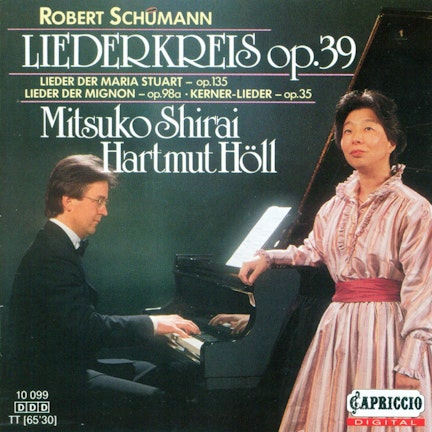
Justinus Kerner, the poet for Schumann's Kerner Lieder Op 35, was a noted doctor and author of a book on parapsychology, whose romantic verse was popular in his time.
Composer's Artistic Vision
Schumann's songs from 1840 were essentially love songs to Clara Wieck, expressing his passion, longing, despair, and fears related to their relationship.
Composer Biography
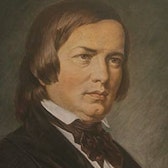
Robert Schumann, despite his literary interests, initially considered vocal music inferior to instrumental music, stating this as late as June 1839.
Composition History
Schumann changed the final song of Liederkreis Op 39 for its 1850 publication, replacing 'Auf einer Burg' with the ecstatic 'Frühlingsnacht' to reflect the happier outcome of his marriage to Clara.
Composition History
The Liederkreis Op 39, based on poems by Joseph von Eichendorff, was described by Schumann to Clara Wieck as 'my most romantic music ever, containing much of you in it.'
Compositional Technique
The Liederkreis Op 39, while not having a clear narrative sequence like Schubert's cycles, is unified by recurrent images, a carefully integrated key scheme, and thematic cross-references.
Composition History
Schumann's sudden prolific song-writing in 1840, when he composed around 140 songs, was largely influenced by his secret engagement to Clara Wieck.