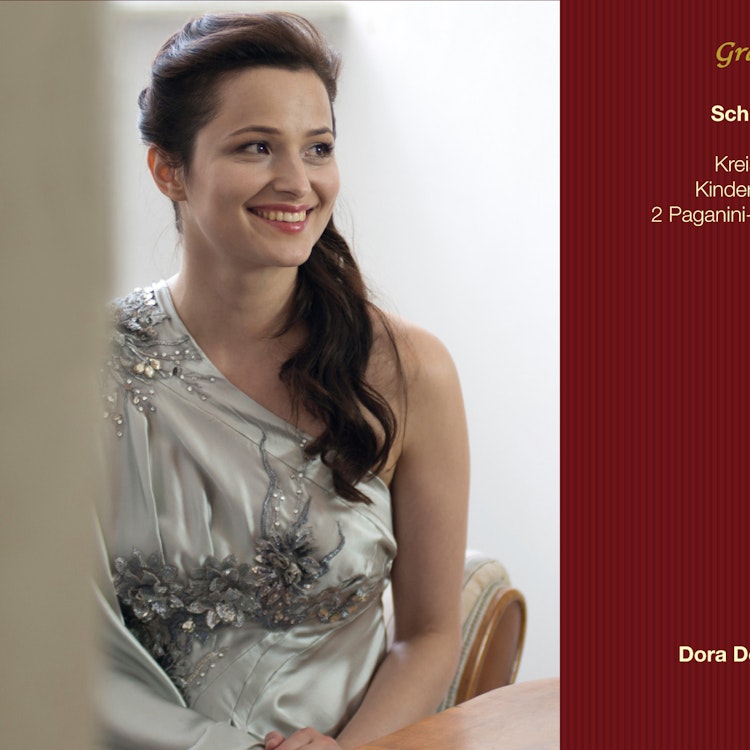
Dora Deliyska, the pianist on this album, has received international acclaim for her recordings of Franz Liszt's works and was awarded the 'Supersonic Award' for her 2013 Schubert CD.
Composer's Artistic Vision
Schumann intended his Kinderszenen to capture moments and moods from a child's life, but from an adult's perspective, reflecting on childhood experiences.
Composition History
Schumann's Six Studies after Caprices by Paganini were directly inspired by a concert given by the 'diabolic violinist' Niccolò Paganini in 1830.
Composer's Artistic Vision
The title Kreisleriana refers to E.T.A. Hoffmann's character Kapellmeister Kreisler, and Schumann adopted this identity to create a musical self-portrait and character sketches of Clara Wieck.
Composition History
Robert Schumann's Kinderszenen (Scenes from Childhood) were inspired by his love for Clara Wieck, despite her father's attempts to keep them apart.
Composition History
Schumann initially intended to dedicate Kreisleriana to Clara Wieck, but due to conflict with her father, he dedicated it to his friend Frédéric Chopin instead.
Composer Biography
Schumann's intense piano practice, aiming to emulate Paganini, may have led to a hand injury in 1832, ending his career as a pianist and possibly contributing to his later nervous disease.