Robert Schumann, the composer, originally intended to be a performing virtuoso but suffered a self-inflicted hand injury.
Performer Biography
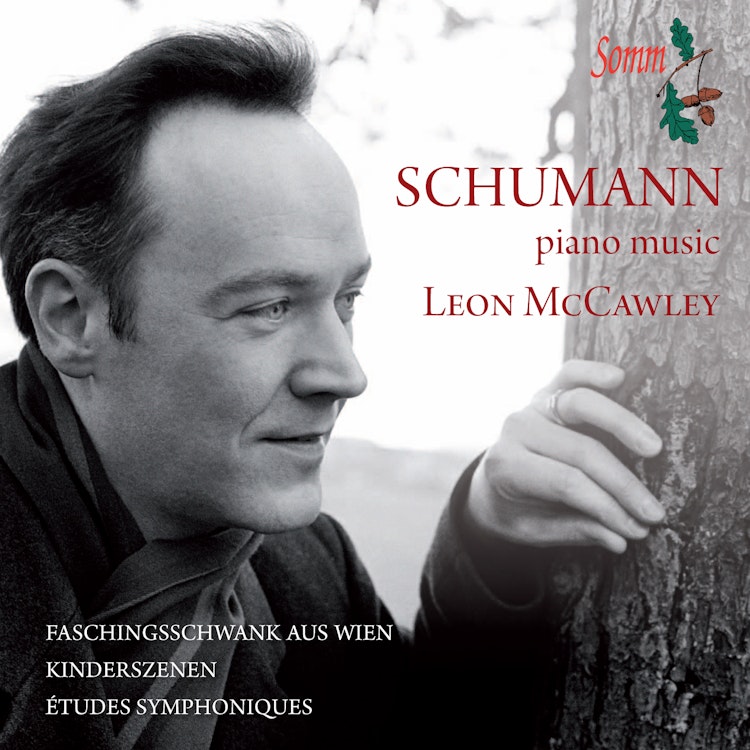
Leon McCawley, the pianist on this recording, won First Prize in the International Beethoven Piano Competition in Vienna and Second Prize in the Leeds International Piano Competition in 1993 at age nineteen.
Compositional Technique
In Faschingsschwank aus Wien, Op. 26, Schumann humorously quotes 'La Marseillaise' as a waltz, despite its ban in Vienna and its revolutionary symbolism in France at the time.
Composition History
Schumann composed the first four movements of Faschingsschwank aus Wien, Op. 26, during a business trip to Vienna in 1839 for his journal, the Neue Leipziger Zeitschrift für Musik.
Composition History
The finale of Schumann's Études Symphoniques is based on a tune from Marschner's popular opera Der Templer und die Jüdin, which was distantly based on Sir Walter Scott's novel Ivanhoe.
Composer's Artistic Vision
Schumann's Kinderszenen, Op. 15, are not pieces for children but poetic evocations of a child's world from a nostalgic adult perspective, described by Schumann as 'Scenes from Childhood'.
Composition History
The Études Symphoniques, Op. 13 by Robert Schumann, uses a theme from Baron von Fricken, an amateur composer and father of Ernestine von Fricken, with whom Schumann was briefly in love.
You might also enjoy...
R. Schumann: Albumblätter, 6 Paganini-Étuden & 5 Gesänge der Frühe
Scenes From Childhood: Piano Music Of Robert Schumann
Schumann: Scenes from Childhood
Schumann : Kreisleriana, Gesänge der Frühe, Variations & Nachtstücke