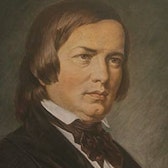
Schumann's mental instability, including struggles with depression and his eventual confinement to an asylum after a suicide attempt, has led some historians to analyze his works through the lens of mental aberration.
Instruments
Violinist Jennifer Koh performs on a 1727 'Ex Grumiaux Ex General DuPont' Stradivari violin, generously loaned to her by a private patron.
Compositional Technique
Schumann's violin sonatas frequently shift between major and minor modes, contributing to a feeling of steadily-evolving thematic exploration and unifying the works through recurring themes.
Composition History
Schumann's Third Violin Sonata originated from a collaborative 'F-A-E' sonata, a gift for violinist Joseph Joachim, to which Schumann, Johannes Brahms, and Albert Dietrich each contributed movements.
Composition History
All three violin sonatas by Robert Schumann were composed during his unhappy tenure as general music director in Düsseldorf, a period that was nonetheless highly productive for his compositions.
Composer's Artistic Vision
Violinist Jennifer Koh finds Robert Schumann's music to be profoundly human, encompassing extremes of haunting, obsessive, tender, and vulnerable emotions.
Compositional Technique
A prominent characteristic of Schumann's violin sonatas is the piano's significant role, often introducing themes or elaborating on passages, making them true duo-sonatas.
You might also enjoy...
Beyond Horizons
Sonatas for Violin and Piano
Grieg: Violin Sonatas
Schumann: Violin Sonatas 1-3
Franck & Lekeu: Violin Sonatas
Franck & Fauré: Violin Sonatas in A Major
Grieg, E.: Violin Sonatas Nos. 1-3
Schumann: 3 Sonatas for Violin & Piano
Franck: Violin Sonata No. 3 in C Minor - Grieg: Violin Sonata in A Major
Grieg: The Violin Sonatas
Fauré: Les deux sonates pour violon et piano, Op. 13 & 108
Brieuc Vourch, Guillaume Vincent; Richard Strauss, César Franck; Sonaten
Schumann, Brahms & Dietrich: F-A-E Sonata
Fuchs: Violin Sonatas Nos. 4-6
Fauré: Violin Sonata No. 1 in A Major, Op. 13 - Saint-Saëns: Violin Sonata No. 1 in D Minor, Op. 75 - Franck: Violin Sonata in A Major, FWV 8