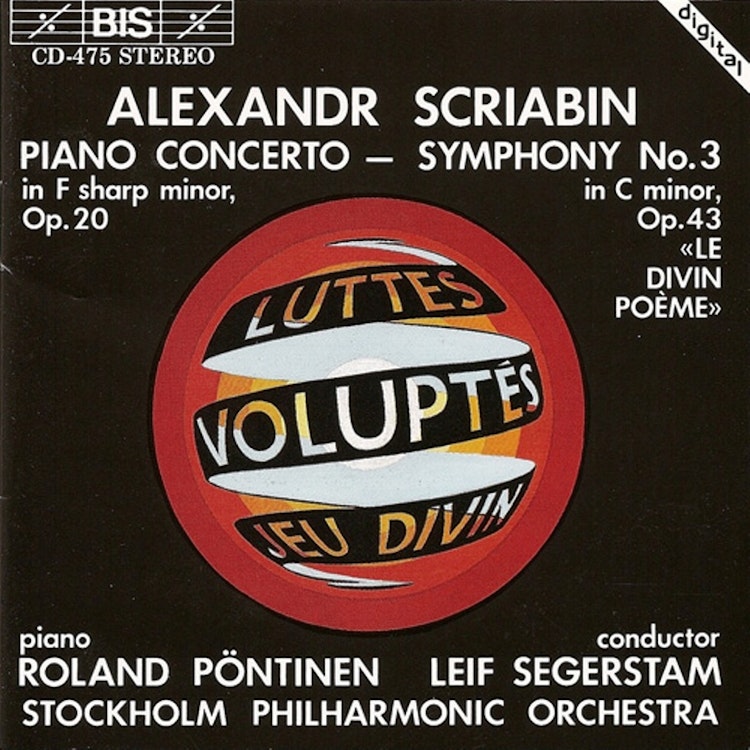
Scriabin: Piano Concerto / Symphony No. 3, "Le Divin Poeme"
8/31/1991, 6 Tracks, 1:17:16
Featuring
Leif Segerstam
Roland Pöntinen
Royal Stockholm Philharmonic Orchestra
Alexander Scriabin
Did you know?
1/7
Composition History
Scriabin's Piano Concerto in F sharp minor, Op. 20, was his first true orchestral composition, which he worked on while proofreading his piano preludes and impromptus.
Composer's Artistic Vision
Scriabin's Symphony No. 3, 'The Divine Poem', was not intended to portray the composer as God, but rather to reflect the philosophy and aesthetic standpoint of the symphony.
Composer Biography
Scriabin, like many other Bolsheviks, adopted a 'nom de guerre'; his nephew Molotov's name means 'hammer', similar to 'Stalin' (steel) and 'Lenin' (River Lena).
Compositional Technique
The large orchestral forces in Scriabin's 'The Divine Poem', including eight horns and five trumpets, are used sparingly over long periods, not as an end in themselves.
Compositional Technique
The Piano Concerto's construction is typical for Scriabin, with a horn melody in the orchestral introduction developing into a thematic kernel for all three movements.
Performer Biography
Leif Segerstam, the conductor on this album, is also a prolific composer, having written 261 string quartets and 61 violin concertos, reflecting his origins as a violinist.
Composer Biography
Alexandr Scriabin, the composer, was the uncle of Vyacheslav Molotov, who later became a prominent Soviet politician and Ribbentrop's pact partner.
You might also enjoy...
ARSM II, Vol. 17. Scriabin
Scriabin: Symphony No. 2 / Piano Concerto
Schnittke: Concerto for Piano and Strings - Prokofiev: Symphony No. 2