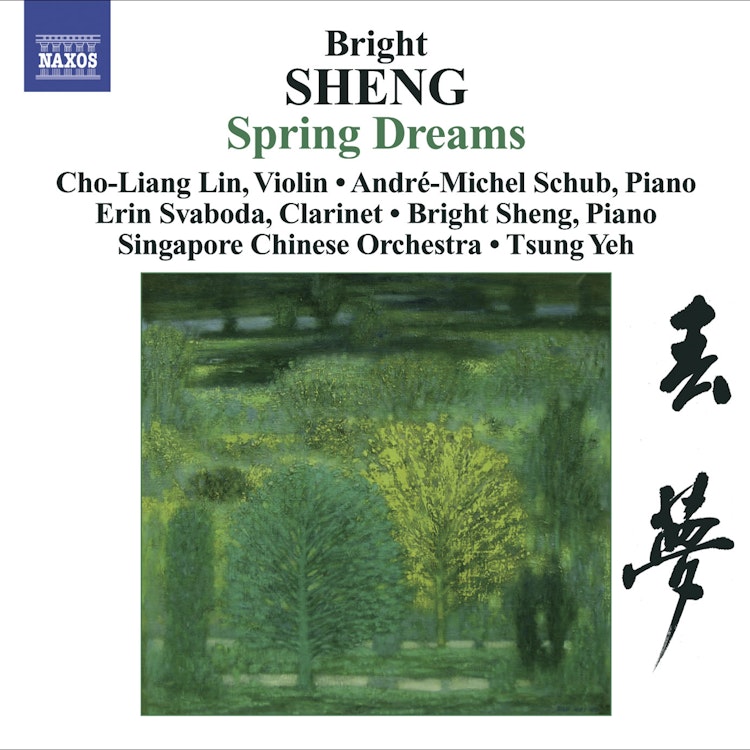
Sheng, Bright: Spring Dreams / 3 Fantasies / Tibetan Dance
7/27/2009, 8 Tracks, 47:52
Featuring
Tsung Yeh
Cho-Liang Lin
André-Michel Schub
Erin Svoboda
Bright Sheng
Singapore Chinese Orchestra
Did you know?
1/7
Performer Biography
Cho-Liang Lin, the violinist on this recording, has had a career spanning 27 years, appearing with virtually every major orchestra in the world since his debut at age nineteen.
Historical Context
The Chinese orchestra, for which Bright Sheng composed, was invented in the 1950s by Chinese Communist leaders to match Western orchestral traditions.
Composer Biography
Bright Sheng's intercultural explorations began at age fifteen, working for seven years during China's Cultural Revolution as a pianist and percussionist in a folk troupe near the Tibetan border.
Compositional Technique
Bright Sheng's compositions for Chinese orchestra often incorporate Western cellos and double basses to reinforce the lowest register, as traditional Chinese instruments generally do not play below a violin's open G string.
Composer Biography
Bright Sheng met Leonard Bernstein at the 1985 Tanglewood Music Festival, and Bernstein became one of Sheng's most potent artistic influences.
Composer's Artistic Vision
Bright Sheng, the composer, embraces 'cultural license,' reflecting his appreciation and understanding of both Western European and Chinese cultures in his work.
Composer's Artistic Vision
Bright Sheng's philosophy centers on the 'cantus firmus phenomenon,' believing that music must have a singing quality, which contributes to the broad accessibility of his music.
You might also enjoy...
Silvestrov : Dedication & Post Scriptum
Korngold: Violin Concerto in D Major, Op. 35 (Live)
Pascal Dusapin: À Quia, Aufgang & Wenn du dem Wind...
Echoes of Time
Kancheli: Middleheim & 18 Miniatures
Grieg: Violin Sonata No. 3 in C Minor, Op. 45 - Sibelius: Violin Concerto in D Minor, Op. 47 - Svendsen: Romance in G Major, Op. 26 (Arr. for Violin & Piano)
Sibelius, Svendsen & Grieg: Violin Works
Anne-Sophie Mutter - Recital 2000
Kremerata Musica - Mahler / Schönberg / Berg / Webern