In 1936, Shostakovich faced public criticism in Pravda for his opera Lady Macbeth of Mtsensk, leading him to withdraw his Fourth Symphony and seek ideologically approved styles.
Compositional Technique
Shostakovich's Fourth String Quartet, composed in 1949, deliberately uses Jewish themes in response to the Communist Party's antisemitic campaigns against 'rootless cosmopolitans'.
Notable Performances
The Glazunov Quartet premiered Shostakovich's First String Quartet in 1938, but the Beethoven Quartet became his preferred performers, premiering all subsequent quartets up to the Fourteenth.
Compositional Technique
The Fifth String Quartet features Shostakovich's musical signature, 'DSCH' (D, E-flat, C, B-natural), and incorporates a theme from his former student Galina Ustvolskaya's Clarinet Trio.
Composer's Artistic Vision
Shostakovich conceived his first string quartet as a potential beginning of a cycle of twenty-four quartets, each in a different key, and was planning his sixteenth at the time of his death in 1975.
Composer Biography
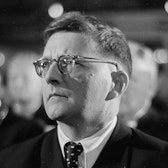
Dmitri Shostakovich began writing string quartets relatively late in his career, in 1938, despite already being renowned as a symphonist and opera/ballet composer.
Historical Context
In 1948, Shostakovich, along with Prokofiev, Myaskovsky, and Khachaturian, was accused of 'formalist tendencies' by the Communist Party, leading to financial hardship and composing 'for the drawer'.
You might also enjoy...
100 Years of Radio
New World Quartets
Insights
Janacek: String Quartets Nos. 1 and 2 / Szymanowski: String Quartets Nos. 1 and 2