Shostakovich: Piano Quintet & String Quartet No. 2
11/10/2023, 9 Tracks, 1:10:26
Featuring
Edward Dusinberre
Károly Schranz
Geraldine Walther
András Fejér
Marc-André Hamelin
Takács Quartet
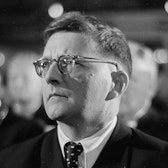
Dmitri Shostakovich
Did you know?
1/7
Critical Reception
Shostakovich's Piano Quintet in G minor, Op. 57, was awarded a Stalin prize, first class, and is now considered core repertoire alongside works by Schumann, Brahms, and Dvořák.
Composer's Artistic Vision
Shostakovich frequently turned to Bachian counterpoint for compositional renewal, a practice that carried extra significance given the pressures he faced in the Soviet Union.
Performer Biography
The Takács Quartet, formed in 1975 at the Franz Liszt Academy in Budapest, was inducted into Gramophone magazine's Hall of Fame in 2012, alongside legendary artists like Jascha Heifetz and Leonard Bernstein.
Historical Context
Between the ages of ten and thirty, Shostakovich experienced the overthrow of the Tsarist autocracy, the Bolshevik coup, and the rise of Joseph Stalin, among other tumultuous events.
Composition History
Shostakovich composed his String Quartet No. 2 in A major, Op. 68, in 1944, with the Beethoven Quartet, a pre-eminent Russian chamber ensemble, in mind.
Compositional Technique
The second movement of Shostakovich's String Quartet No. 2, "Recitative and Romance," was composed in a single day, while the first movement took four days to write.
Composer Biography
Early in 1936, Shostakovich's career was threatened by two vicious, anonymous articles in Pravda, the official organ of the Communist Party, which castigated his music.
You might also enjoy...
Eduard Franck: String Quartet and Piano Quintet
Leo Ornstein: Piano Quintet & String Quartet No. 2
Klughardt: String Quartet in F Major, Op. 42 & Piano Quintet in G Minor, Op. 43
May: String Quartet / Fleischmann: Piano Quintet
Klughardt: String Quartet in F Major, Op. 42; Piano Quintet in G Minor, Op. 43