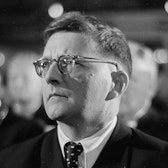
Shostakovich believed that music required intellectual content to be alive and worthwhile, stating, 'for me a musical programme and content are the same thing'.
Compositional Technique
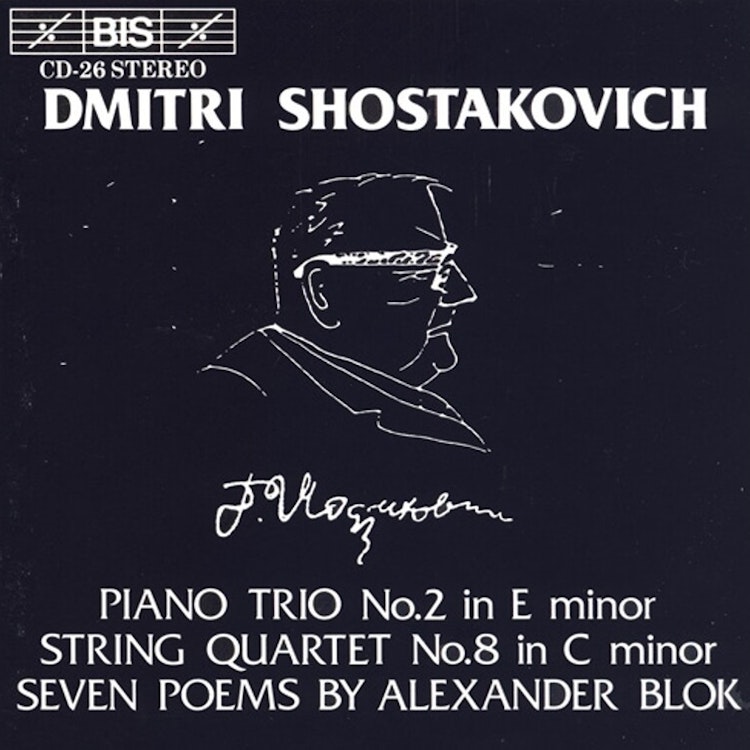
The String Quartet No. 8 uses musical effects to evoke sounds of war, such as bomber planes, sirens, machine guns, and explosions.
Compositional Technique
Shostakovich frequently quoted himself in his String Quartet No. 8, using his musical monogram D-E flat-C-B (D.Sch) as a central motif.
Composition History
Shostakovich chose early poems by Alexander Blok, a leading figure of Russian symbolism, for his Seven Poems by Alexander Blok to commemorate the 50th anniversary of the October Revolution.
Historical Context
Shostakovich's Piano Trio No. 2 was composed in the summer of 1944, when the atrocities in Nazi death camps like Treblinka became widely known.
Composition History
Dmitri Shostakovich dedicated his Piano Trio No. 2 to the memory of his friend, music critic Ivan Sollertinsky, who died in 1944.
Composition History
Shostakovich composed his String Quartet No. 8 in C minor in Dresden, a city ruined during World War II, dedicating it to the victims of war and fascism.
You might also enjoy...
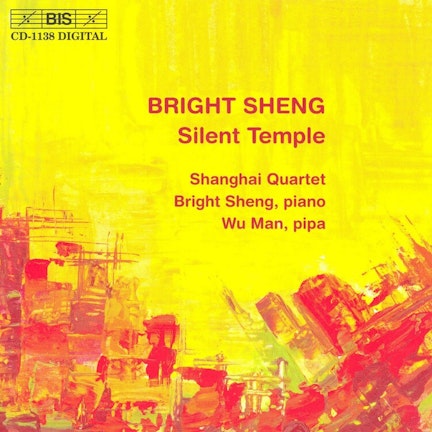
Sheng: Silent Temple
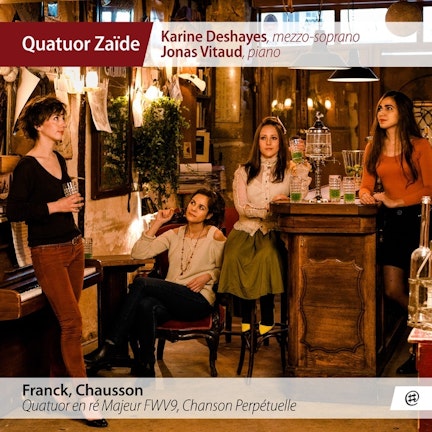
Franck - Chausson
Shostakovich : Piano Trios 1 & 2, 7 Romances on Verses by Alexander Blok
Mozetich, M.: Lament in the Trampled Garden
Erkki-Sven Tüür: Lost Prayers
Shostakovich: Piano Trio No. 2, Viola Sonata & 7 Romances on Verses by A. Blok
Van de Vate: Music for Viola, Percussion and Piano - Nine Preludes for Piano - Trio for Violin, Cello and Piano - Sonata for Viola and Piano - String Quartet No. 1