Shostakovich considered joining the Communist Party in 1960, under pressure from Khrushchev's entourage, to be the lowest point in his life.
Critical Reception
Within a year of its 1945 premiere, Soviet critics censured Shostakovich's Ninth Symphony for its 'ideological weakness' and it was banned for the remainder of Stalin's life.
Performer Biography
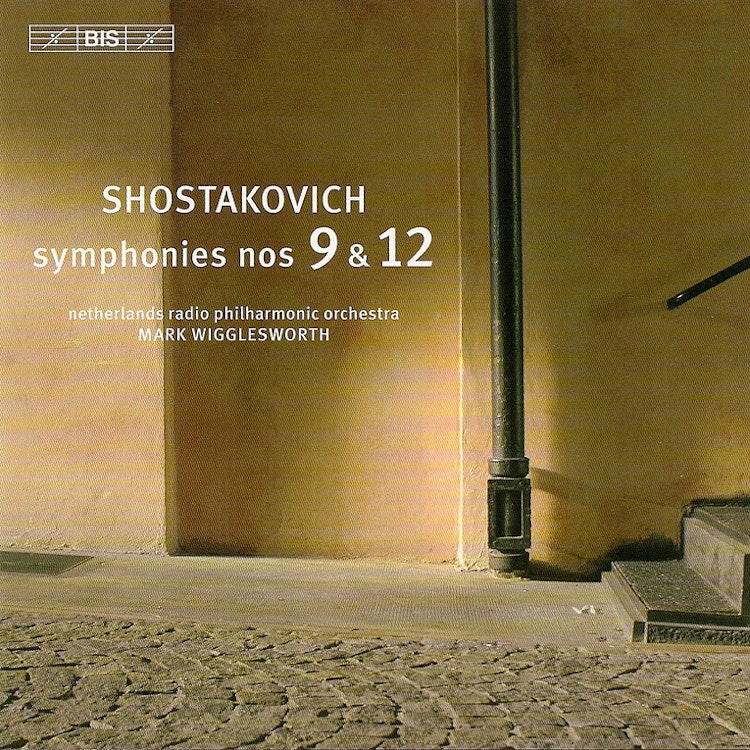
Mark Wigglesworth, the conductor on this album, won the Kondrashin Conducting Competition in the Netherlands in 1989.
Compositional Technique
Shostakovich used a melody from one of his first compositions, 'Funeral March for the Victims of the Revolution', in his Twelfth Symphony over forty years later.
Composer's Artistic Vision
Shostakovich composed his Ninth Symphony as a purely abstract, almost neoclassical work, rather than an empty tribute to Stalin.
Composition History
Shostakovich was commissioned to write his Twelfth Symphony, 'The Year 1917', to commemorate Lenin and the 1917 Revolution for the 22nd Communist Party Congress.
Composition History
Shostakovich's Ninth Symphony was widely expected to be an epic, triumphant victory composition to complete a trilogy of war symphonies.
You might also enjoy...
Shostakovich: Symphony No. 11 in G Minor, Op. 103 "The Year 1905"
Shostakovich: Symphonies Nos. 5 & 1
Shostakovich: Symphony No. 5 in D Minor, Op. 47 (Live)