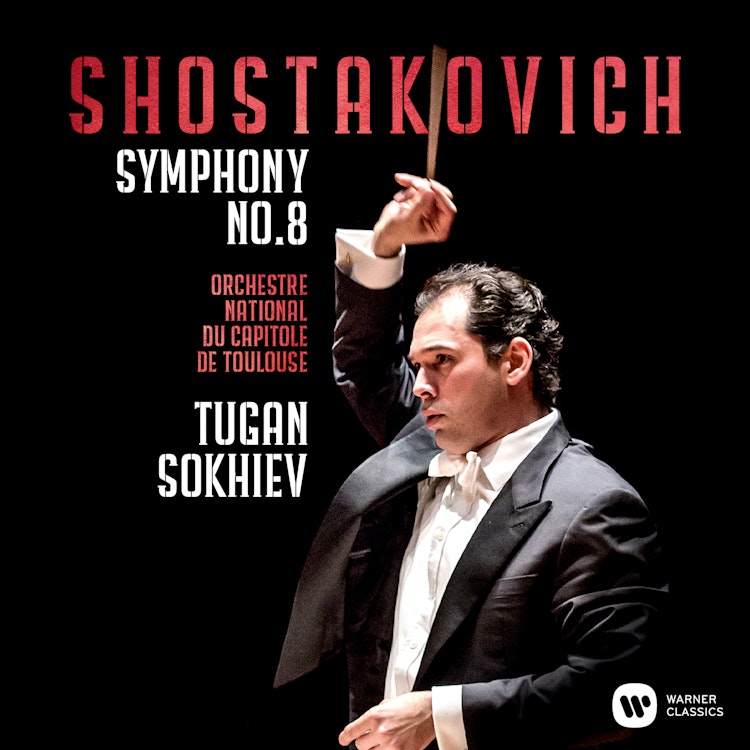
The Orchestre National du Capitole de Toulouse and their music director Tugan Sokhiev release the first album of their new collaboration with Warner Classics: Shostakovich’s huge Symphony No. 8. Written in 1943, this powerfully dramatic symphony is part of a new focus on the music of Shostakovich for this orchestra, under the Ossetian Sokhiev.
Featuring
Tugan Sokhiev
Orchestre National du Capitole de Toulouse
Dmitri Shostakovich
Did you know?
1/7
Performer Biography
Tugan Sokhiev, an Ossetian conductor trained in St Petersburg, became the music director of the Orchestre national du Capitole de Toulouse (ONCT) in 2008.
Composer Biography
Dmitri Shostakovich, the composer, was an avant-garde musician in the 1920s, a controversial figure during the Great Purge, a symbol of resistance to Nazism, and an official composer in the 1960s.
Composer's Artistic Vision
Shostakovich wrote a text for his Symphony No. 8, stating it reflected his thoughts on the Red Army's victories and the post-war period, with a philosophical message that 'all that is dark and shameful will perish, and all that is good will triumph,' though this optimism was a facade for Stalinist ideology.
Interpretation
The recording of Shostakovich's symphonies by Tugan Sokhiev and the ONCT aims to communicate a repertoire, a culture, and an educational tradition, fostering a space for Russian and French musical traditions to merge.
Compositional Technique
Shostakovich's Symphony No. 8 breaks from the traditional four-movement form, featuring five movements in an arch-like structure that begins and ends with two developed movements.
Composition History
In 1943, Shostakovich abandoned an opera project based on Nikolai Gogol's 'The Gamblers' due to unclear reasons, opting instead to compose his Eighth Symphony.
Composition History
Shostakovich composed his Symphony No. 8 in a single burst, while being sheltered from the conflict in Ivanovo, where he socialized with other prominent Soviet musicians.
You might also enjoy...
Shostakovich: Symphony No. 11 in G Minor, Op. 103 "The Year 1905"
Shostakovich: Symphonies Nos. 5 & 1
Shostakovich: Symphony No. 5 in D Minor, Op. 47 (Live)